Sarria to Santiago: Camino Francés Last 100 km Guide for 2027
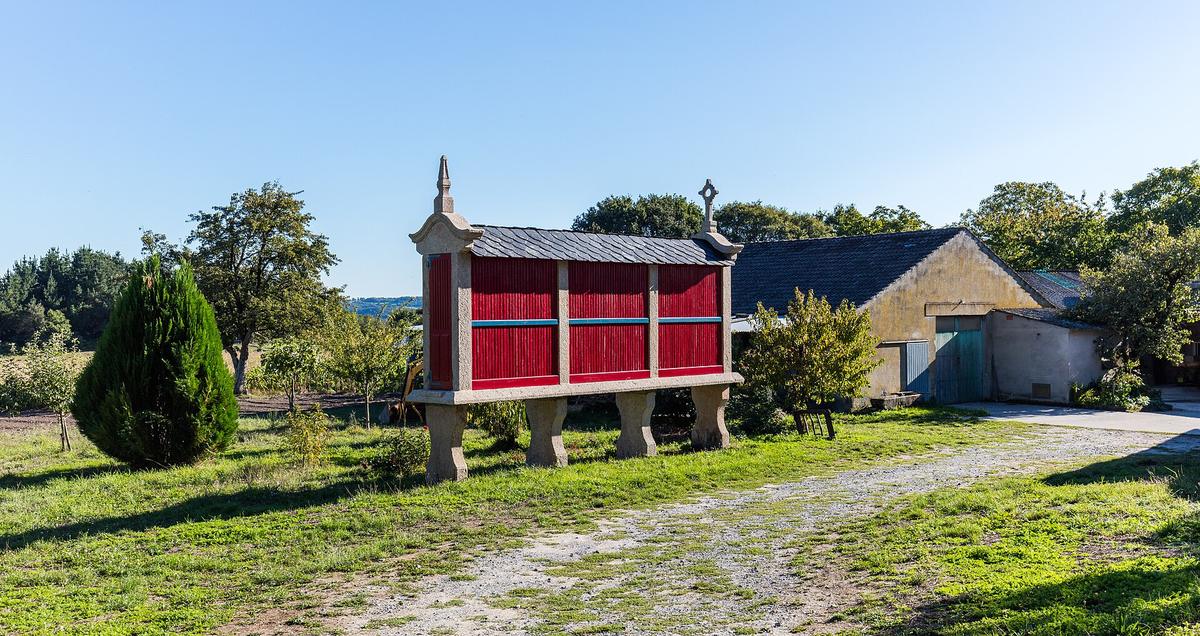
Photo: Diego Delso, CC BY-SA 4.0, Wikimedia Commons

Updated October 2026
Sarria to Santiago is the last 100 km or so of the Camino Francés, and it is the most walked start on any Camino. Most people take five or six days, covering roughly 114 km, and it qualifies for the Compostela because it clears the 100 km minimum on foot. It is also the busiest stretch of the busiest route, which is worth knowing before you book anything.
| Sarria to Santiago at a glance | |
|---|---|
| Distance | About 114 km (published totals range from 111 to 117 km) |
| Time | 5 or 6 walking days is the usual plan |
| Starts in 2025 | About 162,000, roughly 30 to 31% of all Compostelas |
| Feel | Social, busy, well supplied with places to eat and sleep |
| Busiest months | September (the peak), May, August and June |
How long is the Sarria to Santiago walk?
It depends on who is counting, and that matters more than it should. We use the Gronze stage list for the table below, which adds up to 114.2 km. Other published figures for the same walk include 111 km, 113 km, 115 km, 116 km and 117 km. Sources start and end stages in different places and count detours differently. A few GPS-style sources give much larger daily distances, which look like walked-track figures, so we have not used them. Your own watch will probably read a little higher than any table.
The practical point: plan on about 114 to 116 km, and do not worry if your app and your roadbook disagree by a couple of kilometres.
What are the stages from Sarria to Santiago?
Here is the standard five day version. Distances are from Gronze.
| Day | From | To | km | Notes |
|---|---|---|---|---|
| 1 | Sarria | Portomarín | 22.2 | Km 100 marker near Ferreiros. Steep, rocky descent into Portomarín. |
| 2 | Portomarín | Palas de Rei | 24.8 | Climb to Castromaior and the Sierra de Ligonde. |
| 3 | Palas de Rei | Arzúa | 28.5 | The longest day. Passes Melide, where the Camino Primitivo joins. |
| 4 | Arzúa | O Pedrouzo | 19.3 | Comfortable, mostly gentle. The Camino del Norte joins at Arzúa. |
| 5 | O Pedrouzo | Santiago | 19.4 | Lavacolla, Monte do Gozo, then the old town and the cathedral. |
| Total | 114.2 |
Other sources are within about a kilometre of this, and Palas de Rei to Arzúa runs from 28.5 to 29.3 km. Treat every figure as approximate.
On climbing, sources disagree in detail. One compiler (Stingy Nomads) counts about 2,370 m of total ascent over the five days, and gives the first three stages, from Sarria to Arzúa, the biggest climbs, around 500 to 590 m each. The same source lists about 45 km of the route as asphalt. Santiagoways calls Palas de Rei to Arzúa the most demanding stage, while Viaje Camino de Santiago says Portomarín to Palas de Rei. Nothing here is technical: it is a lot of short ups and downs on earth tracks, stone paths and some road.
Should you walk it in 5 days or 6?
Five days is the classic plan, and most fit walkers manage it. The catch is day three, at 28.5 km or a little more, which is long for a day with repeated short climbs and about 11 km of tarmac. If you want an easier rhythm, split it at Melide.
| Day | From | To | km (approx.) |
|---|---|---|---|
| 1 | Sarria | Portomarín | 22 |
| 2 | Portomarín | Palas de Rei | 25 |
| 3 | Palas de Rei | Melide | 15 |
| 4 | Melide | Arzúa | 14 |
| 5 | Arzúa | O Pedrouzo | 20 |
| 6 | O Pedrouzo | Santiago | 19 |
| Total | 115 |
The six day version costs one extra night and buys a kinder day three, a proper lunch in Melide and some slack if a blister appears. We would choose it for anyone new to walking several days in a row, and for older walkers.
Operators use different overnights, so there is no single correct itinerary. Longer plans exist too: one operator's eight day trip has six walking days with overnights in Portomarín, Palas de Rei, Melide, Arzúa and A Rúa, and stages of 14 to 24 km. Starting earlier, in Triacastela, adds a stage of 24.7 km by way of Samos or 17.8 km by way of San Xil.
Where is the km 100 marker?
On the first stage, between Mirallos and A Pena, in the parish of Ferreiros. One distance-marker listing puts Ferreiros at 100.485 km from Santiago. A second source says you pass the marker just beyond Ferreiros.
Sarria is more than 100 km from Santiago (about 114 km by the stage count), so starting there clears the Compostela minimum with room to spare. Santiagoways lists Ferreiros, at about 101 km, as an alternative start if you want the shortest possible distance, but small hamlets like it may have limited beds, so book ahead.
What is Portomarín like, and what else is worth stopping for?
Portomarín is the end of day one and the best-known stop. The original town was flooded when the Belesar reservoir was built (sources put it in the 1950s or 1960s, so we will not pick one), and in dry years parts of the old town show again. The Romanesque fortress-church of San Nicolás (also called San Xoán), from the 12th and 13th centuries, was moved stone by stone to the new site. You enter by the bridge over the Miño and climb a monumental staircase.
Further along:
- Castromaior: an Iron Age hillfort from the 4th century BC, about 20% excavated, on the climb of day two.
- Melide: famous for pulpo á feira, the Galician boiled octopus. The Camino Primitivo joins the Francés here.
- Arzúa: capital of the Arzúa-Ulloa cheese. The Camino del Norte joins here.
- Santa Irene: a small chapel with a fountain traditionally said to heal.
- Lavacolla: the stream where pilgrims traditionally washed before reaching Santiago.
- Monte do Gozo: the hill, about 5 km from the cathedral, where pilgrims first see its towers. A statue of two pilgrims stands there.
You arrive in Santiago through a tunnel of arches into the Obradoiro square.
How crowded is Sarria to Santiago?
Very. About 162,000 people started in Sarria in 2025, out of roughly 531,000 Compostelas issued that year. Sources differ slightly on the exact numbers because they were read on different dates (161,901 in one, 162,076 in another), and they differ on the share too: one says over 32%, but 161,901 divided by 530,844 comes to 30.5%, so we say about 30 to 31%. In 2024 the figure was about 151,000, which sources put at nearly 32% but which divides out at about 30% against a 2024 total of roughly 499,000. The Camino Francés carried about 242,000 of the 2025 Compostelas.
Those are Compostela counts. The Xunta reported in 2026 that its sensors show 1.68 pilgrims for every Compostela issued, so more people are walking than the certificates suggest.
When are the crowds at their worst? In 2025, September was the busiest month with 76,962 Compostelas, which is about 14.5% of the year. Viaje Camino de Santiago puts May, August and June at roughly 14 to 15%, and July and October at about 12%, while Caminoways, reading a chart, gives lower shares for May and June (13% and 12%), so month shares vary by source. November to March together made up only about 7% by Viaje's count. American Pilgrims, which summarises the data, notes that people starting in Sarria or Tui are more likely than average to start in August and September.
What this means on the ground:
- One Sarria guesthouse owner said in July 2025 that she expected to be practically full in July and August, and described July occupancy as very high.
- Municipal albergues (first come, first served) fill by early afternoon in peak weeks.
You can walk it quietly if you work at it. Leave between 6:00 and 8:00 in the morning, stop in smaller places rather than the main stage towns, and avoid Fridays and weekends into Sarria in peak weeks. Small hamlets such as Barbadelo, Morgade, Mercadoiro and Ventas de Narón have limited places to stay, so book those. Forum walkers report heavy crowds in early August and mid-October too, so no month is reliably empty. By the figures above, only November to March is clearly quiet.
You may read dramatic accounts of pilgrims left without beds in Portomarín in 2021. Those happened while hostel capacity was limited to 30% under health restrictions, and are not typical.
Do you need to book accommodation from Sarria?
Not always, but in busy periods yes. Sources advise booking ahead for July and August and long weekends, ideally 24 to 48 hours before at the very least. Outside those periods, arriving before mid-afternoon usually works.
Some facts to plan around:
- Public albergues do not take reservations, open in the afternoon (one 2026 article says 13:00 to 22:00), and allow one night.
- Private albergues, pensions and hotels can be booked.
- Each stage town offers all kinds. At the time of writing, a listing site shows private rooms across Sarria, Portomarín, Palas de Rei, Melide, Arzúa and O Pedrouzo running from about €22 to €130 a night, with public albergue beds around €10 and beds in private albergues listed from about €10 to €22. Stingy Nomads puts private albergues at about €15 to €20. Prices move with season and day of the week, so treat that as a guide only.
- Stingy Nomads estimates about €38 per person per day on a budget at the time of writing.
Luggage transfer is common on this stretch, at about €5 to €6 a bag per stage according to Stingy Nomads at the time of writing. Our guide to luggage transfer is written for the Portuguese Way, but the principle carries over.
What are the Compostela rules for the last 100 km?
The Pilgrim Office (Oficina del Peregrino) sets these:
- You must walk (or ride a horse) at least 100 km on a recognised route, with the final stage ending at the cathedral. Cyclists need 200 km, so cycling from Sarria does not qualify.
- If you began outside Spain, at least 70 km of your walk must be in Spain.
- The Compostela is for those who walk for religious or spiritual reasons, and the Pilgrim Office may ask. Sources disagree on what happens to those who give another reason, so check with the office.
- You need stamps in your pilgrim credential. The Pilgrim Office states that you should stamp it at the start and end of each stage, with the date. In practice, this means at least two stamps a day on the last 100 km. Some volunteers refuse a Compostela if stamps are thin; a few are lenient, but do not count on it.
- Rest days: forum reports agree that you still need stamps for every day you walk, with no gaps in the last 100 km. This is not stated on the Pilgrim Office page.
You can get the credential in Sarria at the church of Santa Mariña, the Monasterio de la Magdalena and some private albergues.
For a fuller explanation, see our guide on how the Compostela works.
How does the Pilgrim Office work on arrival?
The office in Santiago is open daily from 10:00 to 19:00 and is closed on 25 December and 1 January. When you arrive, take a ticket with a QR code and follow the queue live on your phone. In busy periods same-day collection is not guaranteed, so leave yourself a spare night in Santiago if you can. Mornings are recommended.
The Compostela itself is free. The certificate of distance costs €3. One source says that registering online before arrival is required to enter the building, but we could not confirm that on the Pilgrim Office's own site, so check oficinadelperegrino.com before you go.
If you want to see the noon pilgrim Mass, many people leave O Pedrouzo at 7:00 to 7:30 to arrive in time for 12:00. Plan the last evening around it.
How do you get to Sarria?
We will keep this general, because timetables change and the sources we found were dated.
- From Santiago: a direct Monbus bus runs once a day, around 11:00 according to recent sources, and takes just over two hours. Other buses connect via Lugo. There is no direct train from Santiago, so you change somewhere, and the train trip is about two and a half hours.
- From Santiago airport: the same direct bus calls at the airport shortly after leaving Santiago. Otherwise you go into the city by bus first.
- From Madrid: Renfe takes about four hours, and one source lists a single direct Alvia a day, with other options changing at Ourense or Monforte. Flying to Santiago and continuing is the alternative. There is no direct bus from Madrid to Sarria.
- From Lugo: about 30 to 40 minutes by bus or around 20 to 36 minutes by train.
- From A Coruña: we could not confirm times or fares, so check locally.
Check the current Monbus and Renfe times before you commit to flights. Several of the schedules we found dated from 2022.
What should you know before you go?
Most problems on this stretch are small and avoidable:
- Packing too much. Aim for no more than 10% of your body weight. See what to pack.
- Not training. Roughly three walks a week for a month, with your pack and some hills, is a sensible minimum. Our guide to training for the Camino works for this route too.
- Booking every night too tightly. Leave slack for blisters and bad weather. Galicia rain is unpredictable, so carry waterproofs in any month.
- Water. One litre is typical, since bars, cafés, fountains and shops line the route. After Arzúa, nuns on the Camino often offer a stamp, fruit and water.
- A day that is too long. Palas de Rei to Arzúa is the one most people regret skipping a split for.
Is the Sarria to Santiago walk worth it?
Yes, if you want a manageable week, a clear goal, a real Compostela and good company. It is not "cheating"; it is a short Camino, and whether you want company or quiet decides if it suits you.
It suits you if you have about a week, like meeting people along the way, want the classic arrival in the Obradoiro, and prefer plenty of services. It suits you less if crowds spoil walks for you.
What changes in the 2027 Holy Year?
2027 is a Holy Year, because 25 July, the feast of Saint James, falls on a Sunday. The Holy Door of Santiago cathedral opens on 31 December 2026. Sources disagree on the time of the ceremony, so check it. The European Youth Pilgrimage is planned for 15 to 18 July 2027 in Santiago.
What about numbers? There is no official forecast we could find, from the Xunta or anyone else. The Xunta says it expects numbers to rise, and is adding 25 sensors to the 18 it has to plan around flows. The last Holy Year, extended through 2022, saw about 438,300 Compostelas, and 2025 has already passed 530,000 without one.
One local source expects pressure on specific dates and stretches, including Sarria to Santiago, rather than all twelve months. It also warns that Compostela pickup may not be the same day at peak. That is our reading too: if you walk the last 100 km in a Holy Year, expect busier days, tighter beds and a longer Pilgrim Office wait.
Our advice: book earlier than usual, avoid the peak weeks around 25 July and the Youth Pilgrimage if you can, and leave a spare night in Santiago. Our Holy Year 2027 guide is written for the Portuguese Way, but much of it applies.
Sarria or Tui for your last 100 km?
This is a fair question, and the answer depends on what you want from the walk.
| Sarria (Francés) | Tui (Português) | |
|---|---|---|
| Distance to Santiago | About 114 km (Gronze 114.2) | About 115 km (Gronze 115.8, other counts 114.6 to 117.4) |
| Starts in 2025 | About 162,000, around 30 to 31% | About 41,600, around 8% |
| Total ascent (approx.) | About 1,850 to 2,370 m | About 1,380 m |
| Feel | Busier, more social | Quieter, more relaxed |
| Highlights | Portomarín, Melide, Arzúa, Monte do Gozo | International bridge, Pontevedra, Caldas de Reis, Padrón |
Sarria had roughly four times as many starts as Tui in 2025. The Sarria climbing range comes from two compilers (Santiagoways and Stingy Nomads) and the Tui figure from Santiagoways, so read them as a rough guide, not a measurement. Tui is not a perfect 100 km either: the central Portuguese route's 100 km point is O Porriño, so Tui adds about 16 km beyond the minimum.
Sarria is the better choice when:
- You want the busiest, most social Camino atmosphere, with plenty of fellow walkers.
- You are coming from Madrid or want to fly into Santiago and head straight out.
- You want the classic Francés moments: the Portomarín staircase, pulpo in Melide, the walk into the Obradoiro.
- You want the widest choice of places to eat and sleep.
Tui is the better choice when:
- You prefer a quieter walk. Tui has about a quarter of Sarria's volume, though it is not empty: the Pontevedra public albergue has only about 56 beds (up to around 86), with queues by 9:00 in summer.
- You like towns. The route passes Pontevedra, Caldas de Reis and Padrón, with the Valença fortress and the Miño bridge at the start.
- You are coming via Porto, since it is easy to combine with a city stay.
- You want somewhat less climbing, going by the approximate figures above.
We are a Porto company that plans Camino Português trips, not Francés ones, so weigh our view accordingly. Sarria is a good walk, and for many people it is the right one. If you lean towards the quieter side, our Tui to Santiago trip covers the 120 km in six stages with rooms, breakfast, luggage transfer and a roadbook. And our comparison of the two Caminos goes through the decision in more detail.
Our pick: who should walk Sarria to Santiago?
If you have a week, want the best-known last 100 km, and enjoy company, walk from Sarria and take six days. Book your first and last nights ahead, avoid July and August if you can, and leave a free night in Santiago for the Pilgrim Office.
If you want something quieter, with more towns and less climbing, look at Tui. If you have more time, starting earlier on the Francés (from Ponferrada to Santiago is roughly 200 km in 9 to 11 stages, from O Cebreiro or Triacastela is shorter) gives you more quiet days before Sarria. The full Francés from Saint-Jean-Pied-de-Port is roughly 750 to 780 km depending on whose count you use, five weeks or so.
Common questions
How many days does it take to walk from Sarria to Santiago?
Most people take five or six days. The five day plan has stages of 19 to 28.5 km. The six day plan splits the longest stage at Melide and gives easier days of 14 to 25 km.
How many stamps do I need on the last 100 km?
The Pilgrim Office states that you stamp the credential at the start and end of each stage. In practice that means at least two stamps a day. Some volunteers have refused a Compostela where stamps were thin, so collect them every day with the date.
Can I rest for a day and still get the Compostela?
Forum reports say yes, but you still need stamps for every day you walk, with no gaps in the final 100 km. Plan any rest day in a place where you can get a stamp, such as a hotel, church or café.
Do I need to book accommodation from Sarria?
In July and August and on long weekends, yes, ideally well ahead. Public albergues do not take bookings and fill early in peak weeks. Outside those times, arriving before mid-afternoon usually works.
Is Sarria to Santiago too crowded?
It is the busiest stretch of the Camino, with about 162,000 starts in 2025. September, May, August and June are the busiest months. Early starts and smaller overnight stops make it calmer.
What is the hardest stage from Sarria?
Sources disagree. One names Palas de Rei to Arzúa, the longest day, as the most demanding. Another names Portomarín to Palas de Rei for its climb. Splitting day three at Melide takes most of the sting out of it.
Can I cycle from Sarria and get a Compostela?
No. Cyclists need at least 200 km, and Sarria is only about 114 km from Santiago. On foot the minimum is 100 km.
Is Sarria or Tui better for the last 100 km?
Neither is better in general. Sarria is busier, more social and better supplied. Tui is quieter, looks to have somewhat less climbing on the figures we found, and passes through more towns. About four times as many people started in Sarria as in Tui in 2025.