Walk Porto → Baiona, the Atlantic half of the Coastal.
From €650 sharing · €930 solo
- Distance
- about 135 to 150 km
- Nights
- 8
- Walking days
- 6 stages and a boat day
- Daily distance
- 13 to 34 km
- Rooms
- Private room, private bathroom
- Breakfast
- Included
- Bags
- Moved every day
- Price
- €650 sharing · €930 solo
One booking. Eight nights. Zero logistics.
Everything below is priced in euros and per person. What you see is what the package is.
What's included
- Hand-picked rooms with private bathroom: all 8 nights, breakfast included, in the towns where the stages end.
- Daily luggage transfer: one bag up to 20 kg per person, moved door to door while you walk with a daypack. The same for a solo walker, no supplement.
- Digital roadbook + GPX tracks: stage notes for your phone, plus files for any GPS app or watch.
- Pilgrim credential: your stamp book, ready at your first hotel.
Optional extras
- Extra nights before, during or after the walk: €110 per room per night in the walking towns, €125 in Porto and Santiago, one or two people
The 8 nights, stage by stage.
The seven day plan of our Porto to Baiona guide, which splits the first stage at Vila do Conde and the last at Oia to ease the hardest days. Distances vary by source and by the variants you take: treat every figure as approximate.
- Night 1 Arrive in Porto
Settle in, collect your credential, eat well; the boardwalks start tomorrow.
Night 230 to 34 km
The 25 km are measured from Matosinhos. You cross the lifting bridge over Leixões harbour into Leça da Palmeira and pass the Boa Nova lighthouse. Then boardwalks over the dunes lead through Angeiras, Labruge, Vila Chã, Mindelo and Azurara. The day is flat, with under 120 m of ascent, and ends at the Ave bridge into Vila do Conde.
↑ 26 m↓ 0 mNight 320 to 25 km
Flat and coastal. You pass through Póvoa de Varzim, then go north on the seafront and boardwalk through A Ver-o-Mar and Aguçadoura, past old windmills above the dunes, to Apúlia. A track between pines and eucalyptus leads to Fão and over the Cávado into Esposende. There is no climb, about 100 m of ascent in total.
↑ 25 m↓ 0 mNight 421 to 24 km
The day the sea disappears. After the São João Baptista fort the route leaves the coast at Marinhas and goes on through Belinho and Antas, crossing the river Neiva on granite slabs with no handrail. Several short, steep pulls follow, the high point about 130 m at Castelo do Neiva, about 300 m of ascent in all. A forest path leads to Chafé and Anha, and the great iron bridge over the Lima takes you into Viana.
↑ 142 m↓ 0 mNight 519 km
Out of Viana on a country road through Areosa, past the Quinta da Boa Viagem, to Carreço. From Carreço the route climbs through forest to the Cruzeiro at about 14 km, with stony descents and a steep pull on the way. It is about 230 to 260 m of ascent in all, and downhill from the Cruzeiro to Âncora.
↑ 144 m↓ 4 mNight 613 to 19 km
Two halves with a boat between them. You walk from Âncora past Moledo to Caminha; the variant through the pine forest of the Mata do Camarido adds only 1.1 km and is the better walk. After the water taxi it is about 4 km from the landing to A Guarda: the road climbs from the pier and the route loops round the foot of Monte Santa Trega. The arrows are sparse in places, so keep the GPX track open.
↑ 18 m↓ 0 mNight 713 km
North along an exposed Atlantic shore, with the sea on your left, on side roads, a path beside the main road and a rougher coastal section at sea level. There is no climb of note, about 125 to 150 m of ascent, but distance, wind and no shade make this coast hard. Guidebooks measure A Guarda to Mougás at about 19 km and to Oia at about 13 km, so the split with the next day depends on where you sleep.
↑ 53 m↓ 0 mNight 815 to 18 km
A short day. From Mougás the route passes Pedra Rubia and A Ermida, then climbs the Camiño da Portela, a pitch of about 20 per cent, hard but not long, with a fine, solitary descent to Baredo. One shorter climb follows before you drop into Baiona. It is about 190 to 250 m of ascent in all.
↑ 123 m↓ 0 m
Press a stage to see the day.
Route data © OpenStreetMap contributors, ODbL
Payment and cancellation
- 25% deposit of the package price confirms the booking. Of that, €150 per person is a booking fee that is not refunded if you cancel.
- Balance due 42 days before your start date. Book inside 42 days and the full price is payable at confirmation. If the balance has not arrived 7 days after the due date, the booking is cancelled. You may also pay the full price at booking.
If you cancel, we refund what you've paid, less the €150 per person booking fee:
| Notice before the start date | Refund |
|---|---|
| 42 days or more | 100%, less the booking fee |
| 41 to 21 days | 50%, less the booking fee |
| 20 to 14 days | 25%, less the booking fee |
| Under 14 days, or no-show | 0% |
Porto to Baiona, answered.
The questions we hear most about this trip, answered plainly.
Booking and payment
How do I book this trip?
Send the request form with your month and how many of you are walking. We write back with the plan, night by night, and the price for your dates. This trip is planned on request: it is not on the online checkout.
What does the price cover?
€650 per person with two sharing a double or twin, or €930 walking solo in your own room every night. That is 8 nights with private bathroom and breakfast, your bag moved every walking day, the roadbook and GPX tracks, and the credential. An extra night costs €110 per room in the walking towns.
The walk
Do I get a Compostela for Porto to Baiona?
No. The Compostela needs at least 100 continuous km on foot ending at Santiago cathedral, and this walk ends in Baiona. Baiona to Santiago, at about 121 to 133 km, qualifies on its own, so the two halves make the whole Coastal in two trips.
Is there a ferry from Caminha to A Guarda?
Not a scheduled public ferry. Pilgrims cross by private water taxi in about 10 to 15 minutes, and the crossing is confirmed the day before, with the train to Valença as the fallback. Spain is one hour ahead of Portugal, so boat times are in the local time of the port you board at.
What is the difference between the Senda Litoral and the official Coastal route?
The Senda Litoral stays on the shore, on promenades, sand and boardwalks, with patchy waymarking. The official Camino da Costa follows yellow arrows and alternates between coast and inland. You can switch during the day.
How do I get back to Porto from Baiona?
A bus to Vigo, about 40 minutes to an hour, then the train to Porto, about 2.5 hours. Buses replace trains between Vigo and Valença until 7 April 2027, so check cp.pt for your day.
When is the best time to walk it?
May, June, September and October are the most recommended, with March to October walkable. Winter has fewer daylight hours and a very limited boat timetable.
Rooms and bags
How does the luggage transfer work?
Each morning you leave one bag, up to 20 kg per person, at your hotel's reception with its tag, and walk with a daypack. The bag is driven to your next night's hotel and is there by late afternoon. Valuables, medication and what you need on the trail stay in the daypack.
How does my bag cross the Minho?
It goes round by road over the bridge upstream and arrives later than usual at A Guarda. You cross with your daypack only.
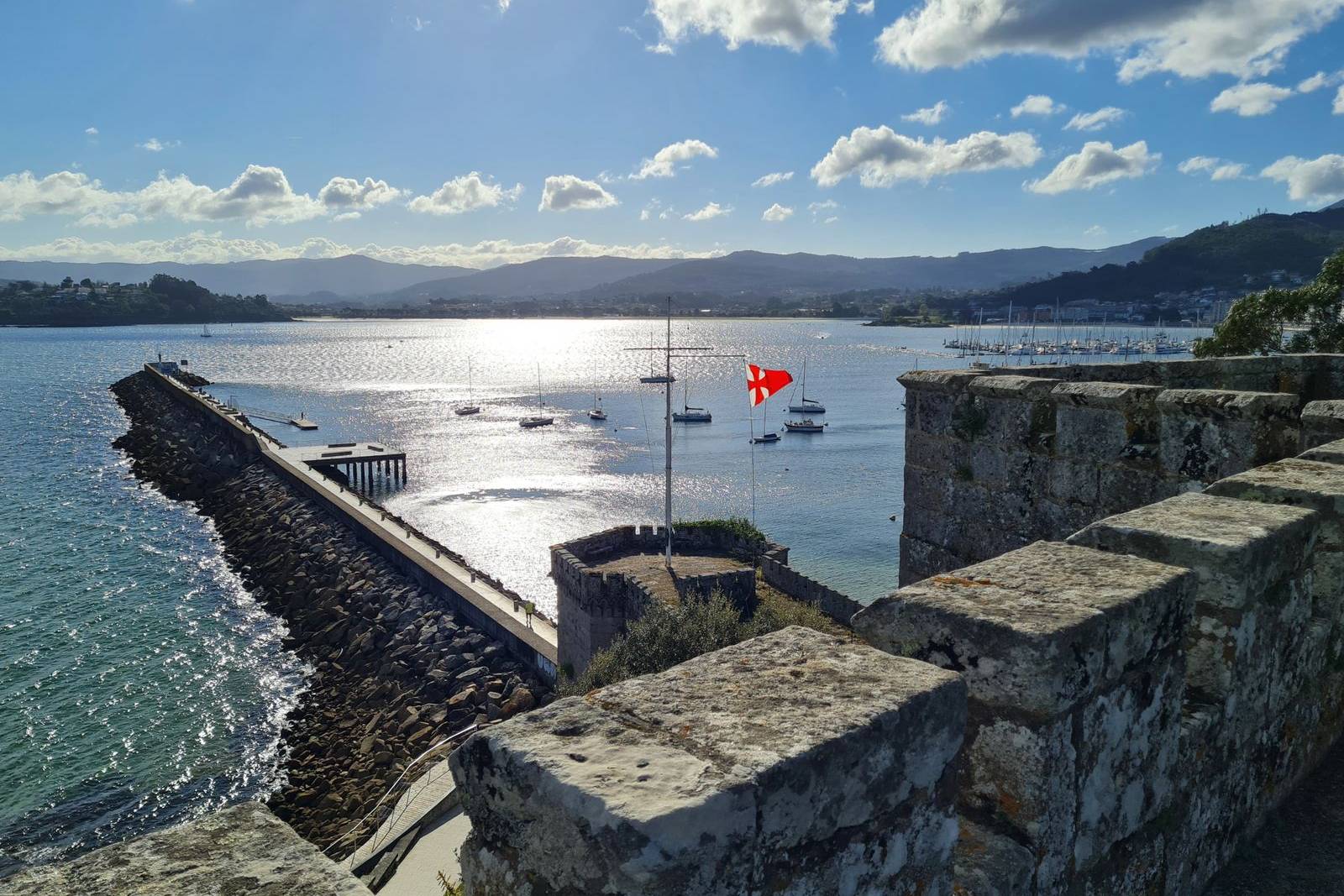
Porto to Baiona is the first half of the Camino Português Coastal: about 135 to 150 km along the Atlantic, on boardwalks over the dunes and through working fishing towns, crossing the Minho by boat from Portugal into Galicia. It makes a complete week of walking on its own.
Worth knowing: it does not earn a Compostela, because the 100 km that earns it must end in Santiago. Many people walk this half one year and Baiona to Santiago another. And the coast is exposed: wind and sun are real, shade is scarce on a boardwalk, and early starts matter.
"A week of Atlantic coast, and a small boat into Spain halfway through it."
Read before you decide.
A package is a convenience, not a substitute for knowing your walk. These guides cover the decisions that matter most on this route. Free, no list-joining required.
Porto to Baiona: the Coastal guide
The stages, the Minho crossing, the Senda Litoral and getting home from Baiona.
Read the guide →Coastal or Central? How to choose
The real difference in scenery, difficulty and crowds, and who each route suits.
Read the guide →What to pack, and what to leave at home
What you actually need on an exposed coastal route.
Read the guide →