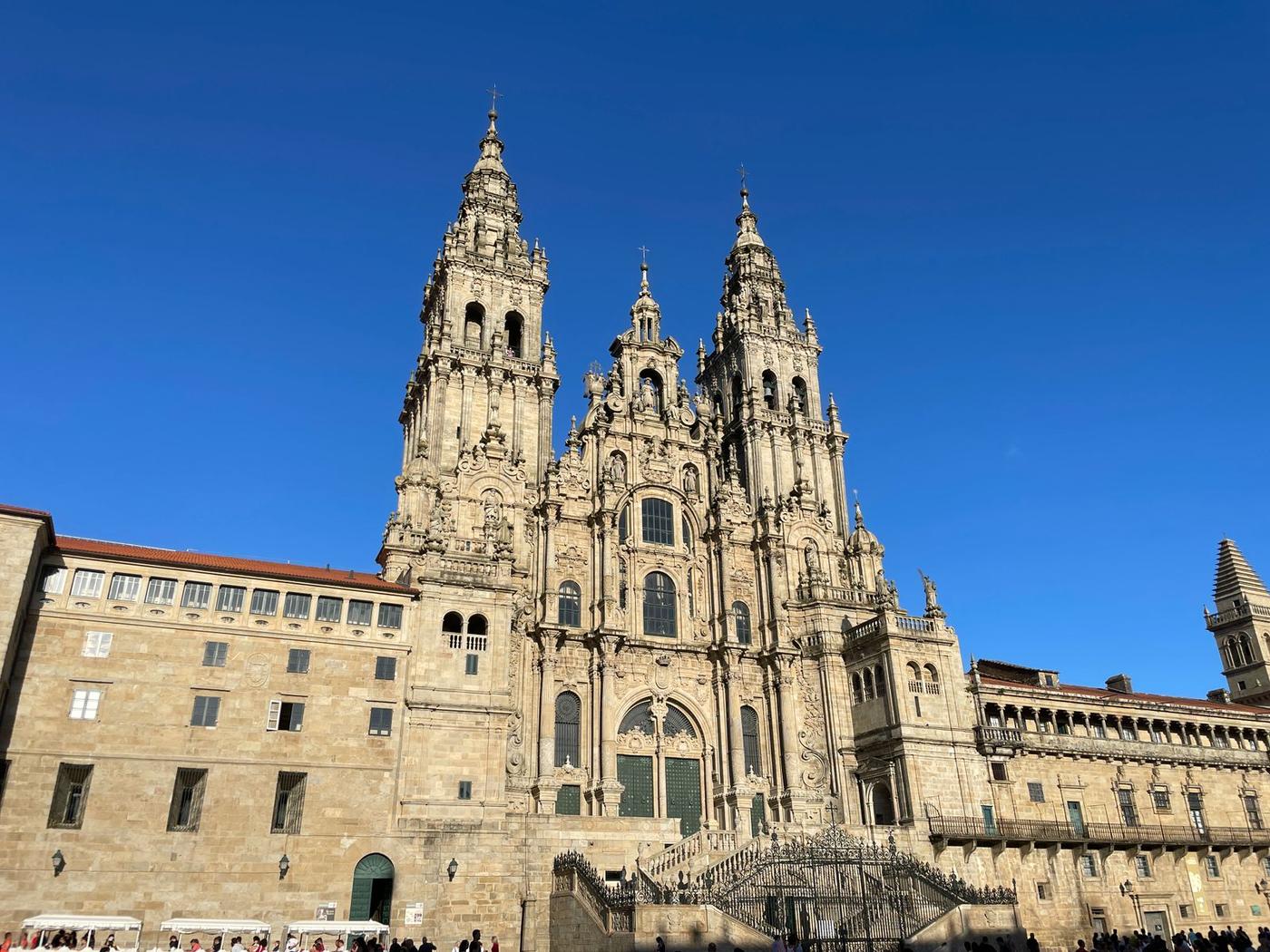
Six nights, 120 km, and a Compostela with your name on it.
From €545 sharing · €785 solo
- Distance
- 120 km
- Nights
- 6
- Walking days
- 6
- Daily distance
- 15 to 25 km
- Rooms
- Private room, private bathroom
- Breakfast
- Included
- Bags
- Moved every day
- Price
- €545 sharing · €785 solo
What €545 actually buys.
No mystery line items. Here's the whole package, what stays your responsibility, and the extras you can bolt on.
Included in every package
- 6 nights in rooms with private bathroom, breakfast included
- Daily luggage transfer between stays, up to 20 kg per person. The same for a solo walker, no supplement.
- Digital roadbook + GPX tracks for your phone
- Pilgrim credential, with a reminder that the last 100 km needs two stamps a day
Optional extras
- Extra nights in Tui, Santiago or mid-route: €110 per room per night in Tui and the walking towns, €125 in Santiago, one or two people
- Santiago → Porto bus, your seat back for the flight home: €25
Six stages, one cathedral.
Real distances for real people: 15 to 25 km a day on mostly gentle terrain, with a bed, your bag and a hot shower waiting at the end of each stage.
Do you need an arrival night in Tui? Most people do not. Vigo airport is about 30 km away, so a morning flight puts you in Tui by lunch and walking to O Porriño the same afternoon. The package starts on the trail rather than the night before. If you would rather sleep in Tui first, add one extra night when you choose your dates and it is priced per night, nothing else changes.
Night 119 km
Out of Tui by the Camiño da Virxe do Camiño, beside the highway, then on dirt track past the old stone bridge of San Telmo to Ribadelouro. At Orbenlle the route splits, and then comes the stretch around O Porriño's industrial estate, the least pleasant walking of the whole route. The day is flat, with about 20 m of climbing in total, and may feel shorter than the table.
↑ 53 m↓ 9 mNight 215 km
The short day, and the one people remember. You follow the Louro valley, with its granite quarries, through Veigadaña to Mos, then climb steadily to the chapel of Santiaguiño das Antas at about 230 m, the last 3 km the steepest. After the chapel it is downhill by Saxamonde to Redondela. Somewhere on the descent the Ría de Vigo opens up in front of you: the first sea view of the walk.
↑ 238 m↓ 5 mNight 321 km
Ups and downs through eucalyptus with estuary views. Soon after Cesantes the road climbs steeply round Monte O Viso to the Alto da Lomba at 168 m, with views over the Ría de Vigo, before dropping to Arcade. Then come the medieval bridge at Pontesampaio, a gentler rise through woodland and fields, and the old causeway at Canicouva. A signed path beside the river Gafos is the nicer way into Pontevedra's old town.
↑ 155 m↓ 0 mNight 421 km
Flat farmland, forest and stretches beside the N-550 road. Out of Pontevedra's old town you cross the pedestrian Burgo bridge, pass under the railway at Alba and follow it for several kilometres. The highest point is San Amaro, at about 120 m, reached by a gentle climb 8 km in. You arrive in the little spa town of Caldas de Reis.
↑ 129 m↓ 2 mNight 519 km
The easiest day of the Galician half. From Caldas a long, beautiful forest stretch leads to Carracedo, with one gentle pull to Casalderrique at about 150 m. Then it is a steady descent through O Pino to the Valga river and on to Pontecesures, where you cross the Ulla. The last 2.5 km, past the Espolón promenade to the church of Santiago in Padrón, are flat.
↑ 163 m↓ 0 mNight 625 km
The build-up day. You leave Padrón past the church of Santiago and the collegiate church of Iria Flavia, then follow country roads to the sanctuary of A Escravitude. A steep road climb follows, then a rolling rise to Milladoiro at about 245 m, the last big suburb, about 400 m of ascent in the day. From there it is down over the Ponte Vella and into the old town, where the cathedral spires appear late.
↑ 262 m↓ 4 m
Press a stage to see the day.
Route data © OpenStreetMap contributors, ODbL
Payment and cancellation
- 25% deposit of the package price confirms the booking. Of that, €150 per person is a booking fee that is not refunded if you cancel.
- Balance 42 days before your start date. Book inside 42 days and the full price is due at confirmation. If the balance has not arrived 7 days after the due date, the booking is cancelled. You may also pay the full price at booking.
Cancel and we refund what you've paid, less the €150 per person booking fee:
- 42 days or more before the start date
- 100%, less the booking fee
- 41 to 21 days
- 50%, less the booking fee
- 20 to 14 days
- 25%, less the booking fee
- Under 14 days, or no-show
- 0%
Travel insurance is required and isn't included. We don't sell insurance, so you buy it in your own name. Full booking conditions.
The last 100 km, answered.
The questions we hear most about this package.
The walk
Do I need to be fit to walk it?
If you can comfortably walk 15 km with a daypack, you can walk this. The stages run 15 to 25 km on mostly gentle terrain, the climbs are short, and your luggage travels by van, so you carry only what you need for the day. Do a few practice walks in the shoes you'll wear, and read our take on how hard the Camino Português really is.
How do I get to Tui?
Travel to Tui isn't included, and most people fly into Porto: from there it's a direct train or bus north to Tui in around two hours. Vigo's airport is even closer, about half an hour away. Your digital roadbook lists the exact connections, and at the end we can arrange your bus back from Santiago to Porto for €25.
Will I actually get the Compostela?
Yes. That's the point of starting in Tui. The Pilgrim's Office grants the Compostela to walkers who complete at least the final 100 km, and this route logs 120. Carry the pilgrim credential we give you, collect two stamps a day (cafés, churches and albergues all stamp it) and present it at the Pilgrim's Office in Santiago. The full detail is in our guide to how the Compostela works.
Rooms and bags
I'm walking solo: is this for me?
Very much so. This stretch is one of the most solo-friendly walks in Europe: pilgrims around you all day if you want company, none of the logistics if you don't. You'll have your own room with private bathroom every night, €785 in total (€545 plus a single supplement of €40 a night, 6 nights), and your bag moves without you thinking about it.
This is a walking package on the final stretch of the Central route: we book your rooms, move your luggage and hand you a route you can follow with your phone in your pocket, and you walk it at your own pace, from the old border town of Tui to the cathedral square in Santiago. 120 km, 6 nights, 6 walking stages. €545 per person, two sharing a double or twin. Walking solo: €785 in your own room every night.
Why start in Tui? Because it's the shortest route that still earns you the Compostela. The Pilgrim's Office asks for at least the final 100 km on foot (the famous 100 km rule) and Tui clears it with 20 km to spare. If you have one week of holiday and want to arrive in Santiago a pilgrim rather than a tourist, this is the walk.
It works as a first Camino, as a tight-holiday Camino, and as the week that decides whether you come back for the full route from Porto.
"You walk. We handle the beds, the bags and the what-ifs."
This is the busy stretch, and that's the point.
Everyone walking the last 100 km funnels onto this path, so don't come expecting solitude. Expect company: a steady stream of pilgrims, cafés every few kilometres, pharmacies, menús del día, and someone to say "bom caminho" to all day. That infrastructure is exactly what makes it the ideal first Camino, and the best use of a single week of holiday. But if what you're after is silence and empty trail, this isn't it, and we'd rather tell you now.
Our advice: walk it in spring or autumn, when the weather is kind and the crowd is a hum rather than a queue; here's the month-by-month picture. And if you're short on time but tempted by quieter kilometres, there are other sections worth your week.