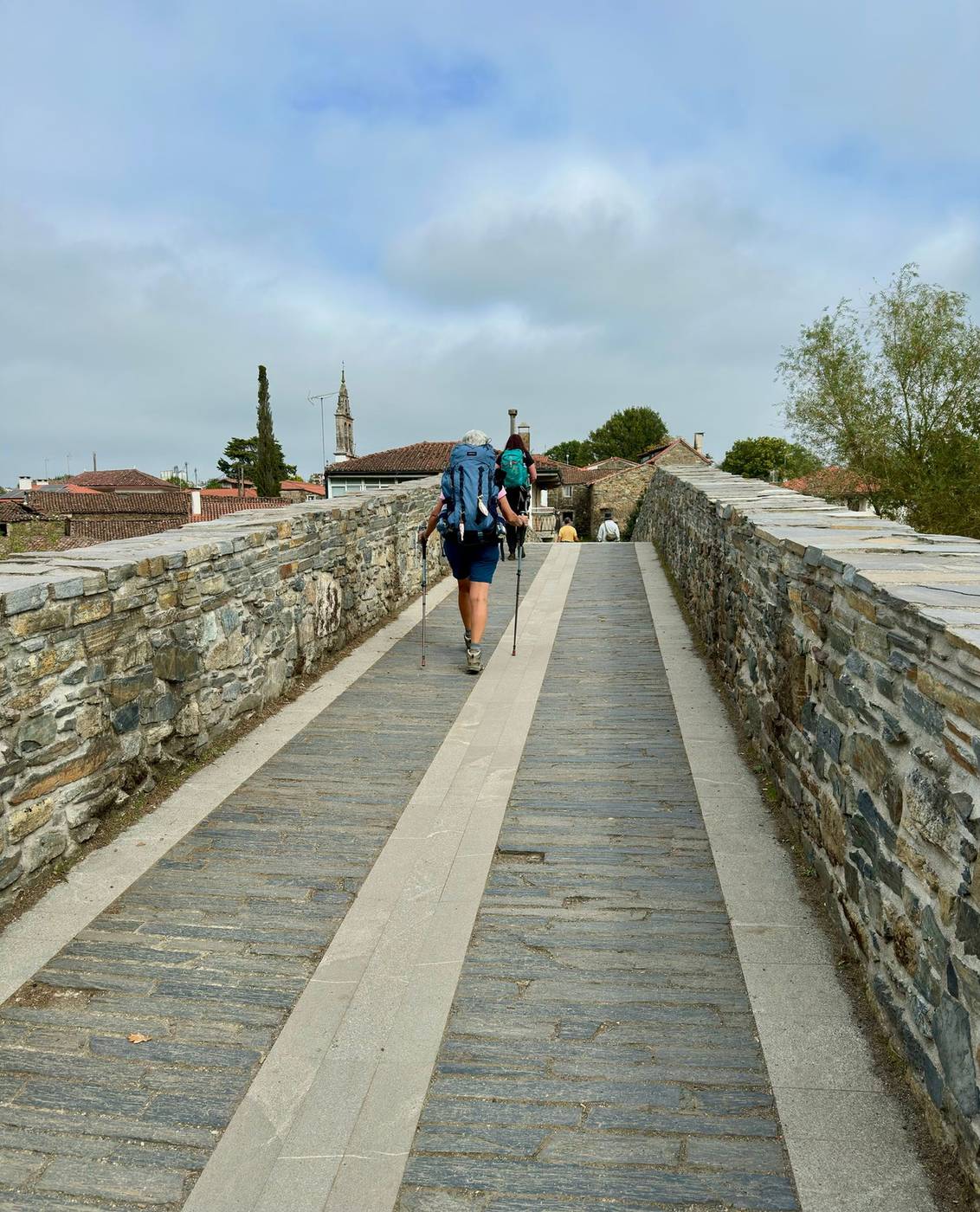
Walk Porto → Santiago, and let us carry the rest.
From €1,095 sharing · €1,575 solo
- Distance
- 246 km
- Nights
- 12
- Walking days
- 11
- Daily distance
- 15 to 34 km
- Rooms
- Private room, private bathroom
- Breakfast
- Included
- Bags
- Moved every day
- Price
- €1,095 sharing · €1,575 solo
One booking. Twelve nights. Zero logistics.
Everything below is priced in euros and per person. No hidden "local payments", no surprise single-room maths; what you see is what the package is.
What's included
- Hand-picked rooms with private bathroom: all 12 nights, breakfast included, in the towns where the stages actually end.
- Daily luggage transfer: one bag up to 20 kg per person, moved door to door while you walk with a daypack. The same for a solo walker, no supplement.
- Digital roadbook + GPX tracks: turn-by-turn stage notes for your phone, plus files for any GPS app or watch.
- Pilgrim credential: your stamp book for the Compostela, ready at your first hotel.
Optional extras
- Extra nights in Porto, Santiago or mid-route: €110 per room per night in the walking towns, €125 in Porto and Santiago, one or two people
- Porto airport pickup: €35 per car, up to 3 walkers with their bags
- Santiago → Porto return bus: €25
The 12 nights, stage by stage.
This is the classic Central-route rhythm: the same stages our free stage guide walks you through, with a bed waiting at the end of each one.
- Night 1 Arrive in Porto
settle in, collect your credential, eat well
Night 227 km
The first 9 km are city and suburb, out through Cedofeita and under apartment blocks and two motorways to Araújo. The suburbs thin out through Moreira da Maia and its industrial estate, and the scenery changes for the better at Barranha, 16 km in. From there it is village lanes through Vilar do Pinheiro, Mosteiró, Gião and Vairão to Vilarinho. There is no climb worth the name, about 290 m of ascent in short rises: the effort is the pavement and cobbles, not the slope.
↑ 118 m↓ 28 mNight 328 km
You drop to the medieval bridge at Zameiro over the Ave within 2 km, cross another medieval bridge at São Miguel de Arcos and reach São Pedro de Rates, with its Romanesque church, at 12 km. After Rates comes a dirt track of more than an hour, then Pedra Furada, Góios, Pereira and Carvalhal. The ground rolls all day with no single climb, the high point about 145 m near Pereira. You arrive by the medieval bridge over the Cávado into Barcelos.
↑ 158 m↓ 4 mNight 434 km
The longest day, the one to start at first light. From Barcelos you climb through Lijó to Portela de Tamel, gaining about 130 m in the last 2.3 km, then drop on a long dirt track through Quintiães to the Ponte das Tábuas and Balugães. After Vitorino dos Piães a firm ascent on asphalt takes you over the Portela da Facha at about 190 m, roughly 970 m of ascent in the day. You arrive along the riverside avenue beside the Lima and its medieval bridge.
↑ 196 m↓ 1 mNight 518 km
Short, but it carries the largest climb of the Camino Português. You leave Ponte de Lima by the bridge and follow the Labruja river, one of the prettiest stretches of the route, to Codeçal. From there it is about 315 m of ascent in 4.2 km to the Alto da Portela Grande de Labruja, near 400 m, steepening on a stony track after the Cruz dos Franceses. The descent runs through Agualonga and São Roque, then a forest track into Rubiães.
↑ 413 m↓ 5 mNight 619 km
Downhill in tendency all the way to the river Minho. From Rubiães you cross a bridge of Roman foundation, climb to the sanctuary of São Bento da Porta Aberta at about 275 m, then run down through the woods to Fontoura and Valença. The international bridge into Spain is at 17 km. The day ends with a climb up the old streets of Tui to the cathedral.
↑ 275 m↓ 0 mNight 719 km
Out of Tui by the Camiño da Virxe do Camiño, beside the highway, then on dirt track past the old stone bridge of San Telmo to Ribadelouro. At Orbenlle the route splits, and then comes the stretch around O Porriño's industrial estate, the least pleasant walking of the whole route. The day is flat, with about 20 m of climbing in total, and may feel shorter than the table.
↑ 53 m↓ 9 mNight 815 km
The short day, and the one people remember. You follow the Louro valley, with its granite quarries, through Veigadaña to Mos, then climb steadily to the chapel of Santiaguiño das Antas at about 230 m, the last 3 km the steepest. After the chapel it is downhill by Saxamonde to Redondela. Somewhere on the descent the Ría de Vigo opens up in front of you: the first sea view of the walk.
↑ 238 m↓ 5 mNight 921 km
Ups and downs through eucalyptus with estuary views. Soon after Cesantes the road climbs steeply round Monte O Viso to the Alto da Lomba at 168 m, with views over the Ría de Vigo, before dropping to Arcade. Then come the medieval bridge at Pontesampaio, a gentler rise through woodland and fields, and the old causeway at Canicouva. A signed path beside the river Gafos is the nicer way into Pontevedra's old town.
↑ 155 m↓ 0 mNight 1021 km
Flat farmland, forest and stretches beside the N-550 road. Out of Pontevedra's old town you cross the pedestrian Burgo bridge, pass under the railway at Alba and follow it for several kilometres. The highest point is San Amaro, at about 120 m, reached by a gentle climb 8 km in. You arrive in the little spa town of Caldas de Reis.
↑ 129 m↓ 2 mNight 1119 km
The easiest day of the Galician half. From Caldas a long, beautiful forest stretch leads to Carracedo, with one gentle pull to Casalderrique at about 150 m. Then it is a steady descent through O Pino to the Valga river and on to Pontecesures, where you cross the Ulla. The last 2.5 km, past the Espolón promenade to the church of Santiago in Padrón, are flat.
↑ 163 m↓ 0 mNight 1225 km
The build-up day. You leave Padrón past the church of Santiago and the collegiate church of Iria Flavia, then follow country roads to the sanctuary of A Escravitude. A steep road climb follows, then a rolling rise to Milladoiro at about 245 m, the last big suburb, about 400 m of ascent in the day. From there it is down over the Ponte Vella and into the old town, where the cathedral spires appear late.
↑ 262 m↓ 4 m
Press a stage to see the day.
Route data © OpenStreetMap contributors, ODbL
Most days sit between 15 and 28 km; stage 3 into Ponte de Lima is the one long stage, and if that number worries you, an extra night (€110 per room) breaks it in two. Prefer a different pace altogether? Email us before you book and we'll talk it through.
Payment and cancellation
- 25% deposit of the package price confirms the booking. Of that, €150 per person is a booking fee that is not refunded if you cancel.
- Balance due 42 days before your start date. Book inside 42 days and the full price is payable at confirmation. If the balance has not arrived 7 days after the due date, the booking is cancelled. You may also pay the full price at booking.
If you cancel, we refund what you've paid, less the €150 per person booking fee:
| Notice before the start date | Refund |
|---|---|
| 42 days or more | 100%, less the booking fee |
| 41 to 21 days | 50%, less the booking fee |
| 20 to 14 days | 25%, less the booking fee |
| Under 14 days, or no-show | 0% |
The package, answered.
The questions we hear most about this trip, answered the same way we write the guides: plainly.
Booking and payment
What happens after I create an account?
Nothing scary. There's no deposit and no obligation: you're creating an account, not signing a contract. You'll get occasional updates, and when bookings open, account holders choose their 2027 dates first, including the Holy Year. If it stops being useful, ask us to delete the account and it all goes.
The walk
How fit do I need to be for 246 km?
Reasonably active, not athletic. Most days sit between 15 and 28 km on gentle terrain, with one long 34 km day into Ponte de Lima. And because your bag travels by van, you walk with only a daypack, which changes everything. If you can comfortably walk a few hours back to back on consecutive days, you can train the rest. For the unvarnished picture, read our guide to how hard the Camino Português really is.
When should I go?
Late spring (May to June) and early autumn (September to early October) are the sweet spots: warm but walkable, long daylight, the trail lively but not overwhelmed. July and August run hot inland on the Central route, and winter is quiet but wet. Our month-by-month weather guide breaks down every month so you can pick with your eyes open.
Is this a good option for women walking solo?
The Camino Português is one of the world's most walked, best waymarked trails, and women walk it alone in large numbers every year. This package gives you a booked private room every night and your bag handled, for €1,575 in total (€1,095 plus a single supplement of €40 a night, 12 nights) instead of the punishing solo pricing that's typical. We've written about the real questions in our solo female guide to the Camino Português.
Rooms and bags
How does the luggage transfer actually work?
Each morning you leave one bag (up to 20 kg per person) at your accommodation's reception and walk away with just your daypack. While you're on the trail, the bag is driven to your next night's accommodation, so it's waiting when you arrive. It runs every walking day of the itinerary; all eleven transfers are in the price, with nothing to arrange en route.
For years we've told you the truth: you can plan the Camino Português yourself, and our free guides show you exactly how. They're staying free. But plenty of you have written back with the same message: I've read everything, now can you just handle it? This package is that answer.
It's the full Central Route from Porto's cathedral to Santiago's: 246 km over 12 nights and 11 walking stages. You walk it organised, at your own pace, on the classic waymarked way. We book the rooms worth sleeping in and move your bag to the next town every morning.
"You walk every step of it. We make sure the bed is booked and the bag is ahead of you."