Santiago to Finisterre and Muxía Walk: Stages, Days, Tips
Updated October 2026
Short answer: the walk from Santiago de Compostela to Fisterra (Finisterre) and Muxía is about 119 km by the published figures, and about 122 km if you walk to the lighthouse and back. A common plan is 5 days for both towns, 4 if they only want Fisterra, and 6 if they split the last stage at Lires. The hard day is the second one, Negreira to Olveiroa, at 33.6 to 34.3 km depending on who measures it. We would walk Fisterra first and Muxía second, and the reasons are below.
If you have just finished a Camino Português, or any Camino, and you are standing in the Praza do Obradoiro wondering whether to keep going to the sea, this guide is for you. The coast walk is not part of the Compostela. It is a different kind of finish: quieter, windier, and ending at the Atlantic instead of a cathedral.
How far is it from Santiago to Finisterre and Muxía?
There is no single number, and that is normal for this route. The Xunta de Galicia, the regional government that publishes the official stages, gives Santiago to Fisterra town as about 87 km. Add the 3.3 km on to the lighthouse and you reach about 90 km. From there Fisterra to Muxía is another 28.7 km.
Put together, the figure usually quoted as official is 118.8 km to Muxía via Fisterra, or 119.9 km if you go to Muxía first and finish at the lighthouse. Our own sum of the Xunta stage pages, walking everything including the lighthouse and back to town, comes to about 122 km.
Other sites quote anything from 113 to 122 km, and a section below explains why.
How many days does it take?
Four or five days is the standard answer. The usual shape is:
- 4 days to Fisterra only: Negreira, Olveiroa, Cee or Corcubión, Fisterra.
- 5 days to both: the same four, then Fisterra to Muxía as a fifth day.
- 6 days to both: split the last stage at Lires, which sits roughly halfway between Fisterra and Muxía, at about 13.4 and 15.3 km either side (the Xunta sub-sections).
Splitting Negreira to Olveiroa at Santa Mariña or Lago makes it a 6 day walk, or 7 days if you also split at Lires. We say more under the hard day below.
Santiago to Fisterra and Muxía, stage by stage
Here are the stages for the Fisterra-first order. We show the Xunta figures next to Gronze, a long-standing route website, because they differ by up to a kilometre in places. Where a figure is our own arithmetic, we say so.
| Day | From | To | Xunta km | Gronze km | Notes |
|---|---|---|---|---|---|
| 1 | Santiago | Negreira | 20.9 | 20.6 | Climb of about 210 m to Alto do Mar de Ovellas, then Ponte Maceira |
| 2 | Negreira | Olveiroa | 34.3 | 33.6 | The long day. 8 km or more with no bar mid-stage |
| 3 | Olveiroa | Corcubión | 20.7 | 21.4 | Fork at Hospital, no services from Hospital to Cee, first view of the sea |
| 4 | Corcubión | Fisterra town | 10.9 (our sum) | 10.6 | Short day. Lighthouse is an extra 3.3 km each way |
| 5 | Fisterra | Muxía | 28.7 | 27.6 | Exposed coast, Lires is the only village with services |
| Fisterra town | Lighthouse (km 0) | 3.3 | 3.2 | Each way. Already included in some published totals |
The Xunta page for Corcubión to Fisterra ends at the lighthouse and gives 14.2 km. Its last sub-section, 3.3 km, is the lighthouse leg, so Corcubión to Fisterra town is 10.9 km, the figure in our table.
Our sums: the Xunta stages to Muxía via Fisterra town add up to 115.5 km, and 122.1 km with the lighthouse out and back (6.6 km). Gronze's stages add up to 113.8 km without the lighthouse. Both are our arithmetic, not figures either source publishes.
Why do the published distances disagree?
Three reasons, and none of them means anyone is wrong.
The lighthouse. Fisterra town to the lighthouse is 3.3 km on the Xunta page and 3.2 km on Gronze. The "official" 118.8 km is 90.1 km to the lighthouse plus 28.7 km on to Muxía, so it never counts the 3.3 km back to town to sleep. Walk it that way and you are at about 122 km.
The end point. Fisterra first finishes at the Muxía sanctuary. Muxía first finishes at the lighthouse, with the lighthouse leg built into the stage (the Xunta gives 32.0 km for Muxía to the lighthouse, against 28.7 km to Fisterra town). That is why the two orders differ by about 1 km on paper: 118.8 km one way, 119.9 km the other.
The measuring method. Other sites quote 114.6, 115.2, 117, 119.6 and 122 km, and the Spanish tourist board's page says 120 km above a table that adds up to 117. Different start points in Santiago, different variants and different treatment of the lighthouse explain most of it.
Plan for about 122 km if you want everything, and do not worry about a 2 or 3 km gap between your app and a website.
Which day is the hard one?
Negreira to Olveiroa. It is the longest stage on the route: 34.3 km on the Xunta page, 33.6 km on Gronze. Gronze lists 633 m and 525 m of elevation change, difficulty 4, and a walking time of about 8 h 30. The route passes Monte Aro, which the Xunta puts at 556 m (other sites give lower figures, so we quote the official one).
The real problem is food. Santiago Ways puts the longest gap without a bar between Vilaserío (about km 12.7) and Santa Mariña (about km 20.8), more than 8 km. Gronze's service list names no bar between Alto da Pena and Santa Mariña, so treat the gap as 8 km or more. Before it there is a shop-tavern in Zas around km 3 and a cafeteria at Alto da Pena around km 8. After it there is a bar at Santa Mariña and two bar-restaurants at Lago, about km 27.
What we would do:
- Carry food and water for the gap. One walker site mentions a vending machine at about km 15, but do not count on it.
- Start early. The open section after A Pena is exposed, and forum posters report heat there.
- Consider splitting the day at Santa Mariña (about km 21) or Lago (about km 27.6), both of which have places to sleep. The cost is a longer day 3.
- Watch the signs near Gueima and Vilar do Castro. Green arrows lead to A Picota, a different route about 1.3 km off. The AC-400 road junction near Santa Mariña is described as dangerous.
Day 3 has its own gap. After Hospital there are about 13 km to Cee with no services (Gronze says 13.2 km). Sources disagree on whether the last bar is in Hospital or at Logoso, so check before you leave Olveiroa and fill your bottle there.
Fisterra to Muxía is the same story: Lires is the only village with services, so carry your lunch. One walker site totals 2,732 m of ascent from Santiago to Muxía via Finisterre, with about 66 km on asphalt and 51 km on footpaths and gravel. Other sites give lower ascent totals, so read it as "a lot of up and down", not a precise figure.
Where do the routes fork?
At Hospital, a hamlet on day 3, about 5 km after Olveiroa. The Xunta describes it as a roundabout where the route splits toward Fisterra and Muxía. Wise Pilgrim, a route site, describes twin markers at the roundabout.
Left is Fisterra, right is Muxía. From the fork, one source quotes 29.693 km left to Fisterra and 26.589 km right to Muxía on the signposts, though we did not see those figures on an official page.
If you choose only Muxía, Olveiroa to Muxía direct is 32.7 km on the Xunta page, a long day, so many people split it at Dumbría.
Fisterra first or Muxía first?
This is the question people argue about on the forums, and there is no wrong answer. Here is how the two orders compare.
| Fisterra first | Muxía first | |
|---|---|---|
| Scenery | Sea views from day 3, Cee, Corcubión and Langosteira beach | Mostly inland until the last stage |
| Ending | Muxía sanctuary and A Ferida, quiet | Lighthouse and km 0 marker, no out and back |
| Crowds | The busier half comes first | The quieter coast stage is last |
| Lighthouse | 3.3 km out from the town (one source says there is no public bus out to it) | The last stretch, built into the stage |
| Bus home | From Fisterra, many daily | From Muxía, fewer direct buses |
Our pick: Fisterra first. You get the sea earlier, you pass through Cee and Corcubión on the way, and you can do the lighthouse at sunset on the evening you arrive in Fisterra, with a bed to walk back to. The last day, Fisterra to Muxía, is the quietest and least walked, which suits an ending.
Walk Muxía first if the idea of ending at km 0, at the lighthouse, is the whole point for you. You skip the out and back, and you get the symbolic finish. The trade-offs are that sea views come late and that the bus home is thinner from Muxía than from Fisterra.
What is worth seeing along the way?
Ponte Maceira. About 17 km into day 1, a medieval bridge over the river Tambre that the Xunta calls the most notable one on the Camino in this section. Negreira, a few kilometres on, is cited by Hemingway in For Whom the Bell Tolls.
The first view of the sea. On day 3 the Cruceiro da Armada, at 247 m, is where the Xunta says you first see Cabo Fisterra. From there you drop steeply into Cee, the largest municipality on the Costa da Morte, and on to the historic harbour town of Corcubión. Into Fisterra you pass Langosteira beach, where walking the last stretch barefoot is described as a custom by two route sites.
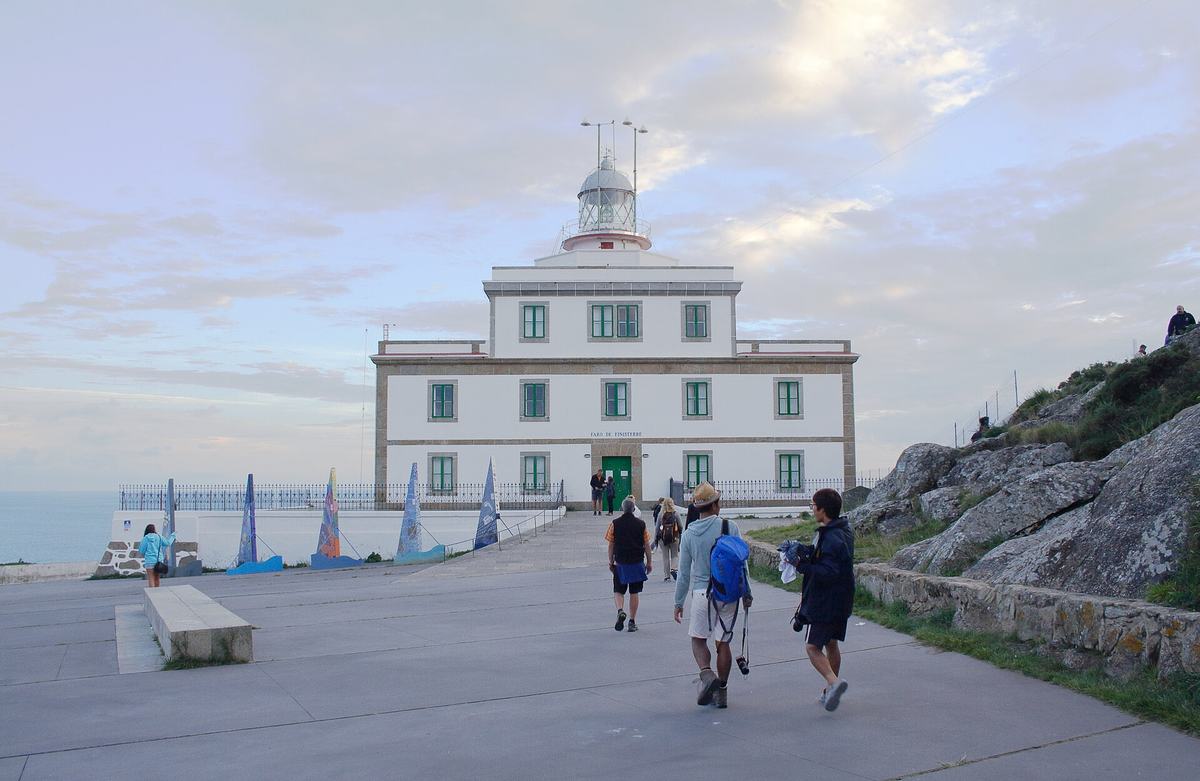
The lighthouse and the km 0 marker. The Xunta marks the lighthouse as km 0 of the Camino. The name Finis Terrae, end of the earth, goes back to when this was the end of the known world. On the way up you pass the church of Santa María das Areas, which keeps the Santo Cristo de Fisterra.
Sunset. Wise Pilgrim recommends the western side of the Fisterra peninsula, about 1 km from the municipal albergue, rather than Langosteira beach. In Muxía, the Corpiño hill (68 m) is the sunset spot.
Burning clothes. Pilgrims used to burn boots or clothes at the cape. It is now discouraged: the Concello and a 2022 campaign, "Buen camino, mejor final", ask walkers not to, because of fire risk. A Spanish press report in 2024 mentions fines for people caught doing it. We did not find a fine amount or the rule behind it, so we will not state one. Please do not light anything. The campaign placed a container for old boots next to the km 0 marker; check on site whether it is still there.
The Muxía sanctuary and its stones. The Santuario da Virxe da Barca sits on the rocks at the edge of the village. The legend says the Virgin arrived in a stone boat to encourage Saint James, and the stones around the sanctuary are that boat: the Pedra de Abalar (the swaying stone, about 70 tonnes, which now moves only intermittently), the Pedra dos Cadrís (the kidney stone, said to heal if you pass it nine times), the Pedra dos Namorados and the Pedra do Temón. A fire on 25 December 2013 destroyed the altarpiece and roof. The Romaría da Barca, a festival of National Tourist Interest, is in September, and rooms in Muxía are scarce then.
A Ferida. Outside the sanctuary entrance stands A Ferida ("The Wound"), a sculpture of over 11 m by Alberto Bañuelos Fournier, inaugurated on 12 September 2003. It honours the volunteers who helped after the Prestige oil spill, which began on 13 November 2002. Muxía's km 0.0 marker is in front of it.
Do you get a certificate, and does it count for the Compostela?
You can get two local certificates, and no, neither replaces the Compostela.
The Fisterrana is issued at the tourist office in Fisterra (and at the public albergue, on certain weekday afternoons). It is free, written in Galician, and described as similar to the Compostela. The Muxiana is issued at the tourist office in Muxía, which one source says is closed on Mondays, and some private albergues issue it too. The Xunta calls it a credencial de final de camino, an end-of-the-way credential.
Both need a stamped credencial. Wise Pilgrim says your stamps are checked, so collect them in Negreira, Olveiroa, Fisterra and Lires, and in Muxía if you are going there. Reaching both towns is not required for either certificate. Opening hours change, so confirm them locally.
The Compostela is separate. The Pilgrim's Office requires the last 100 km on foot into Santiago on a recognised route, ending at the cathedral. Fisterra and Muxía are beyond Santiago, so the coast walk does not add to those 100 km. Collect your Compostela in Santiago first, then start the coast walk.
You may also read that walking from Muxía or Fisterra back to Santiago earns a Compostela. Sources disagree. Muxía to Santiago alone is about 86 km, under the 100 km rule, while a route that passes through Fisterra first is longer. We have not confirmed this with the Pilgrim's Office, so ask them before you rely on it. Our guide on how the Compostela works explains the rules in full.
When is the best time to walk, and how busy is it?
The main season runs from March to November. Autumn, September to early November, is often described as the best, at 10 to 16 °C, with spring at 12 to 18 °C and rain more frequent from October. The only measured figure we found for Fisterra is the October average: a mean of 15.1 °C and 96.6 mm of rain (1994 to 2020, AEMET station). We could not confirm figures for other months.
The weather is the main risk on this route. Fog and drizzle are common in the mornings, and the coast between Cabo Finisterre and Muxía is exposed, with strong winds in storms. Two sites call that stretch dangerous in storms, so allow a spare day if you can.
How busy is it? The Xunta publishes sensor counts. Its sensors recorded 28,470 pilgrims continuing to Fisterra and 11,638 to Muxía between August and November 2025, a total of 40,108 for those four months (Xunta press release, 4 December 2025). That is a sensor count for those months, not a full-year figure. Fisterra to Muxía in particular is described as a stretch where you can walk for hours without meeting anyone.
Book early for Holy Week, Fisterra's Nuestra Señora del Carmen (8 to 10 September) and Muxía's Romaría da Barca.
In winter many places close: a forum thread from December 2023 reported that in January only one of many Negreira albergues was open. Phone ahead.
Where do you sleep, and what about luggage?
Most route pages list only albergues. Here is what exists in hotel and pension terms. We give no prices, because they change by the week.
- Negreira: hotels and pensions, plus many albergues.
- Olveiroa: very little. It has small pensions, such as Casa Loncho and As Pías, and the village has been fully booked on a night in 2023. Book early, and know that Santa Mariña, Lago and Hospital are fallback options.
- Cee and Corcubión: several hotels, so this is where stage 3 usually ends comfortably.
- Fisterra: the widest choice of hotels in town.
- Lires: guesthouses and casas rurales, with a seasonal albergue that is open only from Easter to 31 October.
- Muxía: hotels, rural houses and the Parador Costa da Morte, which is open about 10 months a year.
Luggage transfer exists but is seasonal. Correos (the Spanish post office) offers a Paq Mochila service for the Fisterra and Muxía route, with a limit of 15 kg per bag and a season that runs from Easter to 31 October at the time of writing. Pilbeo, a private carrier, lists a Santiago, Finisterre and Muxía package with a 20 kg limit per bag. We could not confirm whether any of them run in winter, so check before you count on it. Our guide to luggage transfer on the Camino Português covers how it works in general.
How do you get back to Santiago?
By bus, run by Monbus. Timetables here change with the season, so check the current one before you travel and buy the day before if you can, as first-morning buses can sell out.
At the time of writing:
- Fisterra to Santiago: about 7 buses a day on the aggregator listings, around 2 h 20 min direct, from about €7.30. The first is about 08:20 and the last about 18:45.
- Muxía to Santiago: about 1 h 45 direct on one site, around €7, though other listings show longer times. The number of direct buses varies by listing, from two to four a day, so confirm with Monbus.
- Muxía to Fisterra: thin. One listing shows two buses a day for about €3 and about 45 minutes, while another source mentions a change at Cee. A taxi between the two is quoted at about €60. We could not find a taxi price from either town to Santiago.
Fisterra is the easier place to end if you want flexibility, and that matters when you choose your order. If you finish at Muxía, plan your bus before you leave the village that morning.
Walking it in the 2027 Holy Year
2027 is a Holy Year, and many walkers add Fisterra and Muxía after the Holy Door in Santiago. We could not find any figures on how a Holy Year changes the numbers on the coast route, so we will not guess. What we do know is that tour operators are already selling 2027 packages for it. If you are planning to walk in 2027, our guide to the Camino Português in the Holy Year covers how to book. On the coast, the places with the fewest beds (Olveiroa, Lires, Muxía) are the ones to reserve first.
Who it suits, and our pick
The Xunta rates several stages "Alta" for difficulty (it rates the long second day "Media"), and the second day is the longest. It suits people who have already walked a Camino and want to finish at the sea. It is less suited to anyone arriving in Santiago exhausted or injured, so a rest day in the city first is a good idea. Have breakfast before you set off, and take care with the arrows around the cathedral, which walkers find confusing.
Our pick: five days, Fisterra first, with a night in Fisterra for the lighthouse sunset. Split Negreira to Olveiroa if your legs are not used to 30 km days, and split the final stage at Lires if the weather looks poor.
Common questions
How many days does it take to walk from Santiago to Finisterre and Muxía?
Four days to Fisterra alone, and five to reach both. A six-day version splits the Fisterra to Muxía stage at Lires.
How far is the walk from Santiago to Finisterre?
About 87 km to Fisterra town and about 90 km to the lighthouse, by the Xunta stage figures. Gronze gives a similar 86.7 km to town. Santiago to Muxía by the direct fork is about 88 km on the Xunta figures.
Should I walk to Fisterra or Muxía first?
We would go to Fisterra first. You get the sea earlier, you pass through Cee and Corcubión, and the quieter Fisterra to Muxía stage makes a calm ending. Muxía first suits you if finishing at the km 0 lighthouse matters most.
Do I get a Compostela for walking to Finisterre?
No. The Compostela is for the last 100 km into Santiago, and the coast lies beyond it. You can collect the free Fisterrana in Fisterra and the Muxiana in Muxía instead, and both are separate local certificates. Whether a walk back from Muxía to Santiago earns a Compostela is not confirmed, so ask the Pilgrim's Office.
What is the hardest stage?
Negreira to Olveiroa, at 33.6 to 34.3 km depending on the source. There is a stretch of more than 8 km with no bar, so carry food and water, or split the day at Santa Mariña or Lago. The 13 km from Hospital to Cee, with no services, is the second thing to prepare for.
Can I burn my boots at Finisterre?
Please do not. It is discouraged by the local council because of fire risk and the damage to the protected area, and a 2024 press report mentions fines for people who do it. We could not find the fine amount or the rule behind it, so we will not state either.
How do I get back from Finisterre or Muxía to Santiago?
By Monbus. At the time of writing, Fisterra has around 7 daily buses and takes about 2 h 20 min for roughly €7.30, and Muxía has fewer, around 1 h 45 min for about €7 on one listing. Check the current timetable, and know that the link between Muxía and Fisterra is thin.
Can I send my luggage ahead?
Yes, in season. Carriers set limits of 15 to 20 kg per bag, and some services stop at the end of October. We could not confirm winter service, so check before you plan around it.