Spiritual Variant Camino Portugués: Stages, Boat, Compostela
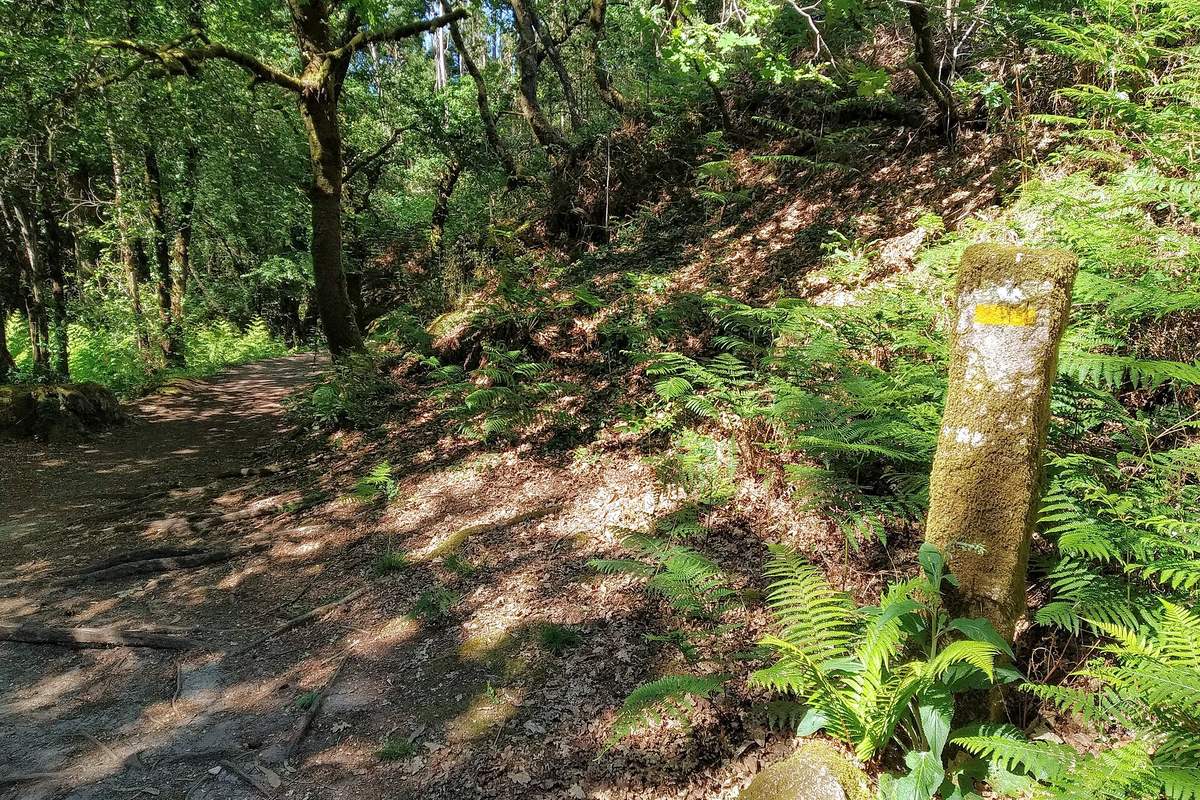
Photo: Lameiro, CC BY-SA 4.0, Wikimedia Commons, cropped

Updated October 2026
The Spiritual Variant (Variante Espiritual) is a three-day detour from Pontevedra to Padrón. It swaps the inland road through Caldas de Reis for a mountain monastery at Armenteira, a stone-mill valley, and a boat up the Ulla river that follows the legend of Saint James. For most walkers it adds one day to the trip. The one thing to settle before you go is the Compostela: the boat is not walking, so plan your route so you do not depend on it.
We build Camino Português trips from Porto, so this guide is written for people on the Central or Coastal route who are wondering whether to turn off at Pontevedra. It covers the stages, the boat, Armenteira, where to sleep, when to go and what the rules say. Where sources disagree, we give the range and say so.
What is the Spiritual Variant of the Camino Português?
It is a signed alternative to the last part of the Central route. Both Central and Coastal walkers reach Pontevedra (the Coastal route joins the Central at Redondela), and about 3 km after the Ponte do Burgo there is a fork near Pontecabras. The Central route carries straight on towards Barro and Caldas de Reis. The Variant turns left across the Gandara river.
It rejoins the main line at Pontecesures, 2.5 km before Padrón. From Padrón you walk the same final stage to Santiago as everyone else.
The Variant is young. It was created around 2011 to 2012 by Tino Lores, who leads the Amigos del Camino Portugués, together with local officials in O Salnés, and Lores himself has called it an invention. The monastery at Armenteira, the legend and the boat are real places and real stories, but the Variant as a named route is modern. It is still a good walk: quiet forest, a working monastery, and a river arrival.
How many days does the Variant add to a Porto to Santiago trip?
About one. The Central route from Pontevedra to Padrón is usually walked in two stages: Pontevedra to Caldas de Reis (around 22 km), then Caldas to Padrón (around 19 km). The Variant takes three: Pontevedra to Armenteira, Armenteira to Vilanova de Arousa, then the boat and a short walk to Padrón.
If you walk rather than sail from Vilanova, it becomes four days, because the walk is long and most people split it at O Carril.
On the boat day you reach Padrón early (one source says before 11 am), so some walkers carry on towards Santiago the same day. We would not plan that as a default, because the boat time depends on the tide and the last stage from Padrón is 23 to 24 km.
Stage by stage: Pontevedra to Padrón via the Variant
Distances differ by source, mostly because of where each one measures from. We give the range.
| From | To | km | Notes |
|---|---|---|---|
| Pontevedra | A Armenteira | 20.5 to 23.2 | Hardest stage. Combarro at about 11 to 13 km, then a long climb |
| A Armenteira | Vilanova de Arousa | 22.7 to 23.4 | Mostly downhill, stone mill valley, few services |
| Vilanova de Arousa | Pontecesures (boat) | about 28 km by water | 1 to 1.5 hours, tide dependent |
| Pontecesures | Padrón | 2.5 | Short walk or end of the boat day |
| Padrón | Santiago | 22.7 to 24.3 | Same as the main line |
Sources: Gronze gives 20.5 and 23.4 km for the first two stages, while the albergue network site and Viaje Camino de Santiago give 23.2 and 22.7 km. One forum poster who walked the second stage reported 28.5 km, so treat any figure as approximate and use the GPX.
Walking all the way from Vilanova takes you about 34 km to Pontecesures and 36 km to Padrón, according to the albergue site. Forum reports describe it as mostly asphalt with patchy signs.
Stage 1: Pontevedra to A Armenteira
You leave a city, follow road shoulders and tracks through Poio, and reach Combarro, the fishing village on the ría, at around 11 to 13 km. After Combarro the path climbs steeply through forest over Monte Redondo, then drops down a rocky stair of natural granite steps into Armenteira. The descent is rough on knees and the sources say it is unsuitable for bikes.
Ascent figures are unofficial. One walker site gives about 606 m up and 358 m down for this stage. Gronze's figures are close to that (578 m and 333 m, unlabelled). Armenteira itself sits at about 363 m.
Services are the problem. Combarro is the last reliable place for food and water before the climb, and forum reports from 2025 say there is nothing between Combarro and Armenteira. Buy lunch and fill your bottles there.
Many walkers split the day with a night in Combarro. You arrive early, see the village, and take the climb fresh the next morning.
Stage 2: A Armenteira to Vilanova de Arousa
This is the easier stage, mostly downhill. Early on it follows the Ruta da Pedra e da Auga, the Route of Stone and Water. Turismo de Galicia lists it as PR-G 170: 6.5 km, about 2 hours 15 minutes, low difficulty, with more than 30 mills. Other sites say up to 50 mills over 7 km, or about 8 km, so we have used the Turismo de Galicia figure. The first section along the Armenteira river is steeper, with some awkward passages. The old path was used by pilgrims on Easter Monday to reach the monastery.
Wet stones are slippery. If it has rained, slow down on the mossy steps.
After the mills there are few services. Gronze lists a seasonal bar in the picnic area within the first 6 km, a restaurant around 6 km, cafes and bars further down, and a bar and restaurant at Gombra (about 14 km). A forum post from August 2025 mentions a bar about 4.5 km from Armenteira open from 08:00 to 15:30. Opening hours change, so carry water and some food.
Vilanova de Arousa is a seaside town. The Valle-Inclán house museum (Casa do Cuadrante) is free for pilgrims according to the Xunta museums site. The same page lists Tuesday to Sunday opening hours, which implies it is closed on Mondays, so check before you go.
Stage 3: the boat, then Padrón
The Variant's famous final leg is by water. The boat leaves Vilanova, crosses the Arousa ría and runs up the Ulla river to Pontecesures. From Pontecesures you walk the 2.5 km to Padrón. The next section covers the boat in detail.
Does the Spiritual Variant count for the Compostela?
This is the question competitor pages answer worst, and the short summary is that sources disagree. We lay out what is firm and what is not.
What the rule says. The Pilgrim Office states that the Compostela needs at least 100 km on foot or horseback (200 km by bike), with a religious or spiritual motivation, and at least two stamps per day certifying where you started and finished. The stages should be in geographical and chronological order. That page does not mention the Spiritual Variant or the boat at all.
What sources say about the Variant and the boat.
- Wise Pilgrim says the Oficina del Peregrino recognises the Variant as an official variant and that you can get a Compostela whether you take the boat or walk.
- Stingy Nomads (2026) says the boat is part of the official route, that it gives a stamp, and that you still need 100 km before: starting in Pontevedra does not qualify, but starting in Porriño or Vigo does.
- A Camino Portugués credencial, quoted in a forum thread, says the Variant must be started at least in Porriño or Vigo for the Compostela.
- Camino Ninja (August 2026) says the Pilgrim Office does not recognise the Variant as a separate route, that the boat kilometres do not count, and that you need 100 walked km before the turnoff.
- RAW Travel says using a boat, train or taxi in the last 100 km technically forfeits the Compostela, and that it is unlikely to be given.
- Forum posters disagree: some report boat riders receiving a full Compostela, others report refusals, and none of the "exception granted" stories we found are documented.
We could not find a dated official ruling from the Pilgrim Office, and the Office's own page is silent. So we do not claim an official position on the boat.
What we advise.
- If you start in Porto, the Compostela is not at risk. Even if the boat counted for nothing, you will have walked far more than 100 km.
- If you start in Tui (the Last 100 km route) you are also fine. Tui to Pontevedra is 53.7 km. Adding the first two Variant stages gives roughly 97 to 100 km before the boat, and the 2.5 km from Pontecesures plus the last day from Padrón add about 25 to 27 km more. These are our sums from the stage table, and they come to around 122 to 127 km walked with the boat excluded.
- If you start in Pontevedra, do not rely on the Compostela. Pontevedra to Vilanova, the 2.5 km to Padrón and the final day to Santiago come to only about 68 to 73 km on foot by the same sums. Vigo is 35 km from Pontevedra, which is why sources name Vigo and Porriño as workable starts.
- Whatever your start, collect two dated stamps every day, and ask the Pilgrim Office before you leave if you want certainty about the boat.
Two other certificates. Padrón issues a Pedronía certificate, which is not a Compostela. There is also a separate Traslatio Xacobea diploma for the sea and river route, which needs a booklet stamped at two intermediate ports. Pilgrim.es says it requires starting in O Grove and stamping at two town halls on the Arousa ría. It is a different thing from the Compostela.
If you want a clean answer rather than a probable one, walk the Variant as part of a trip that starts in Porto or Tui. Our Central, Coastal and Last 100 km routes all give you that. For the full rules on the certificate, read our guide on how the Compostela works.
How does the Traslatio boat from Vilanova work?
The legend. After Saint James was killed, his disciples are said to have carried his body to Galicia in a stone boat with no rudder or sails. They landed at Iria Flavia, the port at the head of the Ulla river, and tied the boat to an altar stone, the pedrón, which is now in the church of Santiago in Padrón. Every year, in late July or early August, a boat procession called the Traslatio re-enacts the journey from the Arousa ports to Pontecesures and Padrón.
Wise Pilgrim notes that the Variant's origin stories are not historical, and the legend is a tradition rather than documented history. It is still the reason the route exists, and the sailing is a good day.
The 17 crosses. Along the water there is a Via Crucis of 17 stone crosses (cruceiros) from Ribeira to Pontecesures, the only maritime and river Way of the Cross in the world, according to the sources we used. It was proposed in the 1960s and mostly built from 1963 to 1965 with donations. You will see some of them from the boat. One source says about 11, depending on the tide, but we could not confirm that.
Operators. There is no official fare list and no fixed public timetable that we could find. These are private operators of two kinds:
- A larger boat, La Barca del Peregrino, which has run since 2006 and is reported to seat around 28 passengers.
- Small open speedboats, such as Amare Turismo Náutico, which reportedly carry about 10 to 12.
Both usually take bookings online or by message.
Price. At the time of writing, 2025 to 2026 sources give about €30 to €32 one way: La Barca del Peregrino's own site says €30, and Amare and Camino Ninja (August 2026) say €32. Older posts quote €20 to €25, so check before you go.
Timing. Departures depend on the high tide, and usually fall early, around 7:00 to 9:00, with a second sailing sometimes in summer. The crossing takes about 1 to 1.5 hours. Wise Pilgrim says schedules depend on the tide, passenger numbers and the captain, so you cannot plan far ahead.
Book ahead. Book the day before at the latest, and confirm the time. One 2023 comment from a pilgrim who did not book says they paid €40 and waited until 14:00. Some posts mention minimum passenger numbers, but the figures (7, 8 or 10) conflict and we could not confirm any, so ask when you book. One source says the boat almost always runs from April to October and otherwise depends on demand, another says winter sailings are for groups of ten or more, and a third says it can be cancelled by tides, weather or low numbers in any season.
What to bring. An early open boat can be cold and fast. Bring a windbreaker. Check with the operator that bags and bikes are accepted.
If the boat does not run. You have three fallbacks:
- Walk. It is 34 to 36 km on mostly asphalt, and the albergue site suggests splitting at O Carril.
- Walk about 8 km from Vilanova to Vilagarcía de Arousa and take the train to Pontecesures. Omio listed a journey of about 18 minutes, around 8 trains a day and fares from about €3 on 30 October 2026, but check Renfe for current times. An older forum post gave €2.35.
- A taxi. One source says there is no public transport from Vilanova to Vilagarcía, so a taxi is the realistic route. We did not research a bus.
What is Armenteira, and is it hard to find a bed?
Armenteira is a small village built around a Cistercian monastery. The monastery was founded in 1168 by a knight, Ero de Armenteira. It was abandoned after the 1835 sale of church lands, rebuilt through a friends' association, and is now home to Cistercian nuns. Vespers is at 19:00 daily and a Mass at 07:30 on weekdays, according to the monastery's site, and a forum post from 2025 mentions a pilgrim blessing after Vespers.
The local legend is a medieval one. Ero listened to the song of a bird for what felt like a few minutes, and when he came back he found that about 300 years had gone by. It is told in Alfonso X's Cantigas (number 103) and was retold by Valle-Inclán in 1907.
The practical problem is beds. Armenteira is the tightest point of the Variant. The public albergue has 17 beds, and a 2025 forum post says only half can be reserved. Other options are:
- The monastery guesthouse, with a small number of pilgrim rooms. Reports on its prices and rules vary, and it is reportedly closed to bookings in some periods, so ask.
- The Pousada de Armenteira, a hotel beside the monastery, which a 2025 forum post says is open from May to October, with limited days in May and June.
- A few small guesthouses and rural houses within a few kilometres, up to about 7 km out.
Book early and book first. If you cannot find a bed in Armenteira, build the rest of the itinerary around where you can, or change the plan so that Combarro is your night and Armenteira is a lunch stop.
Where do you stay on the Variant?
We list types, not prices, because the only prices we found were aggregator snapshots and forum posts that may be out of date.
- Pontevedra. Plenty of hotels. If you are short of beds further along, this is the fallback.
- Combarro and Poio. Small guesthouses and rural houses in Combarro, and Hotel Xeito in Combarro. Choices are limited, so book ahead.
- Armenteira. Scarce: a monastery guesthouse, a seasonal pousada, a public albergue and a few small houses. See above.
- Vilanova de Arousa. A small hotel, guesthouses and apartments, plus private rooms in a private albergue.
- Pontecesures. A rural hotel, a few guesthouses and tourist apartments.
- Padrón. More choice: hotels, guesthouses and apartments in town, and rural manor hotels outside it.
When is the best time to walk the Spiritual Variant?
Spring and early autumn. One albergue guide calls them good, with more demand in summer and slippery stones when it rains. Stingy Nomads suggests April and the second half of October as quieter. The boat nearly always runs from April to October. In winter there are fewer daylight hours, not everything is open, and boat sailings are less certain.
For more detail by month, see our guides on weather month by month and the best months to walk. For what the 2027 Holy Year changes, see our Holy Year guide.
How crowded is the Variant?
Busier than it was, and nobody has a firm count. Two estimates for 2024 conflict:
- More than 34,000 pilgrims, about 20% of the 170,000 or more passing Pontevedra, from the Asociación de Amigos del Camino Portugués.
- 23,845, from a mobile-network data study for the O Salnes association of councils, which said numbers had roughly doubled on earlier years.
Neither is Pilgrim Office data, and the 2025 article behind the first figure says the Variant does not yet appear in the Office's official statistics. We could not find a figure for 2025. August and September are the peak months in the mobile data.
Our reading: it is busy enough that Armenteira beds and boat seats need booking, but it is not a crowd on the scale of the last 100 km into Santiago.
Is the Variant worth it, and who is it for?
Our pick. We think the Variant is worth the extra day for walkers who want fewer roads, a monastery night and an arrival by water, and who will book carefully. It suits:
- walkers on a 12 to 14 night Porto to Santiago trip with a day in hand;
- people who like a changing landscape, with forest, hills, mills and ría;
- people who do not mind that one leg depends on tides and bookings.
It does not suit:
- people who want a fixed schedule with no weather or tide risk;
- bike pilgrims (the rocky steps) or walkers who need an accessible route;
- anyone starting in Pontevedra who needs a Compostela.
Can we add the Variant to a Central or Coastal trip?
Yes, on request. Our standard Central and Coastal trips follow the main line, so the Variant is a custom change. Tell us your dates and we plan it: the Combarro night, the Armenteira room, the boat and the luggage. Do not assume a standard luggage transfer covers the Variant, because the sources say to confirm it.
Use the custom form. Or look at the main-line trips first: Central, Coastal.
Common questions
Does the Spiritual Variant count for the Compostela?
The Pilgrim Office's rule is 100 km on foot with two stamps a day, and its page does not mention the Variant. Sources disagree on whether it is recognised. If you start in Porto or Tui you walk well over 100 km anyway. If you start in Pontevedra, do not rely on it.
Does the boat count as walking?
No. Walking is walking, and the boat is a boat. Some sources say the boat is accepted as part of the official Variant and others say its kilometres do not count. We found no dated official ruling, so ask the Pilgrim Office if you need certainty.
How much does the boat from Vilanova de Arousa cost?
About €30 to €32 one way at the time of writing, from operator and 2026 sources. Older posts quote €20 to €25. Fares are set by private operators, so check when you book.
How much farther is the Spiritual Variant than the main route?
Wise Pilgrim puts the extra walking at about 8.2 km between Pontevedra and Pontecesures, plus the climb over Monte Redondo. In days it adds about one, from two stages to three. Other sources give bigger gaps if you walk from Vilanova instead of sailing.
What if the boat does not run?
Walk 34 to 36 km to Padrón, splitting at O Carril if you wish, or walk about 8 km to Vilagarcía de Arousa and take the train to Pontecesures. A taxi is the third option.
Is it hard to find a bed in Armenteira?
Yes. The public albergue has 17 beds (one forum post says half can be reserved), the monastery guesthouse has few rooms and closes to bookings in some periods, and the pousada is seasonal. Book early, and consider a night in Combarro instead.
What is the Ruta da Pedra e da Auga?
A waymarked walking route (PR-G 170) from Armenteira, listed by Turismo de Galicia as 6.5 km, about 2 hours 15 minutes, with more than 30 old mills. The Variant follows it on stage 2.
Do I need to be religious to walk it?
No. The Compostela rule asks for a religious or spiritual motivation, and the Variant is open to everyone who walks it. Nothing requires you to join the Vespers or the blessing at Armenteira.