What the Camino Português Really Costs: A Realistic Budget
Updated August 2026
Short answer: walking the Camino Português costs roughly €35–50 a day kept simple (municipal albergues, picnic lunches, pilgrim menus) and €90–150+ a day in comfort (private rooms, nicer dinners, bags moved). For the classic 12-day Porto-to-Santiago walk that's broadly €450–600 on a shoestring versus €1,100–1,800 in comfort, before flights. Three things decide the number: where you sleep, whether you carry your own pack, and how you eat. These are ballpark ranges, not quotes; season and standards move them.
| Style | 12 days, on the trail | What you get |
|---|---|---|
| Shoestring | ~€450–600 | Municipal albergues, picnic lunches, pilgrim menus, carry your own pack |
| Middle | ~€750–1,000 | Mix of private dorms and guesthouses, eat out most nights, bags moved on long days |
| Comfortable | ~€1,100–1,800+ | Private room every night, bags moved end to end, dinners for the food not the price |
As a rough guide, walking the Camino Português costs somewhere between €35–50 a day if you go simple (municipal albergues, picnic lunches, a pilgrim menu most nights) and €90–150+ a day if you want private rooms, nicer dinners and your bags moved for you. For the classic 12-day Porto-to-Santiago walk, that's broadly €450–600 on a shoestring versus €1,100–1,800 in comfort, before you add flights. These are ballpark figures, not quotes; prices move with season and standards. Here's how the money actually breaks down, so you can build your own number.
Three things shape your budget more than anything else: where you sleep, whether you carry your own pack, and how you eat. Get a feel for those and the rest is small change.
What do beds cost, and why are they the biggest line?
This is the line that decides whether your Camino is cheap or comfortable.
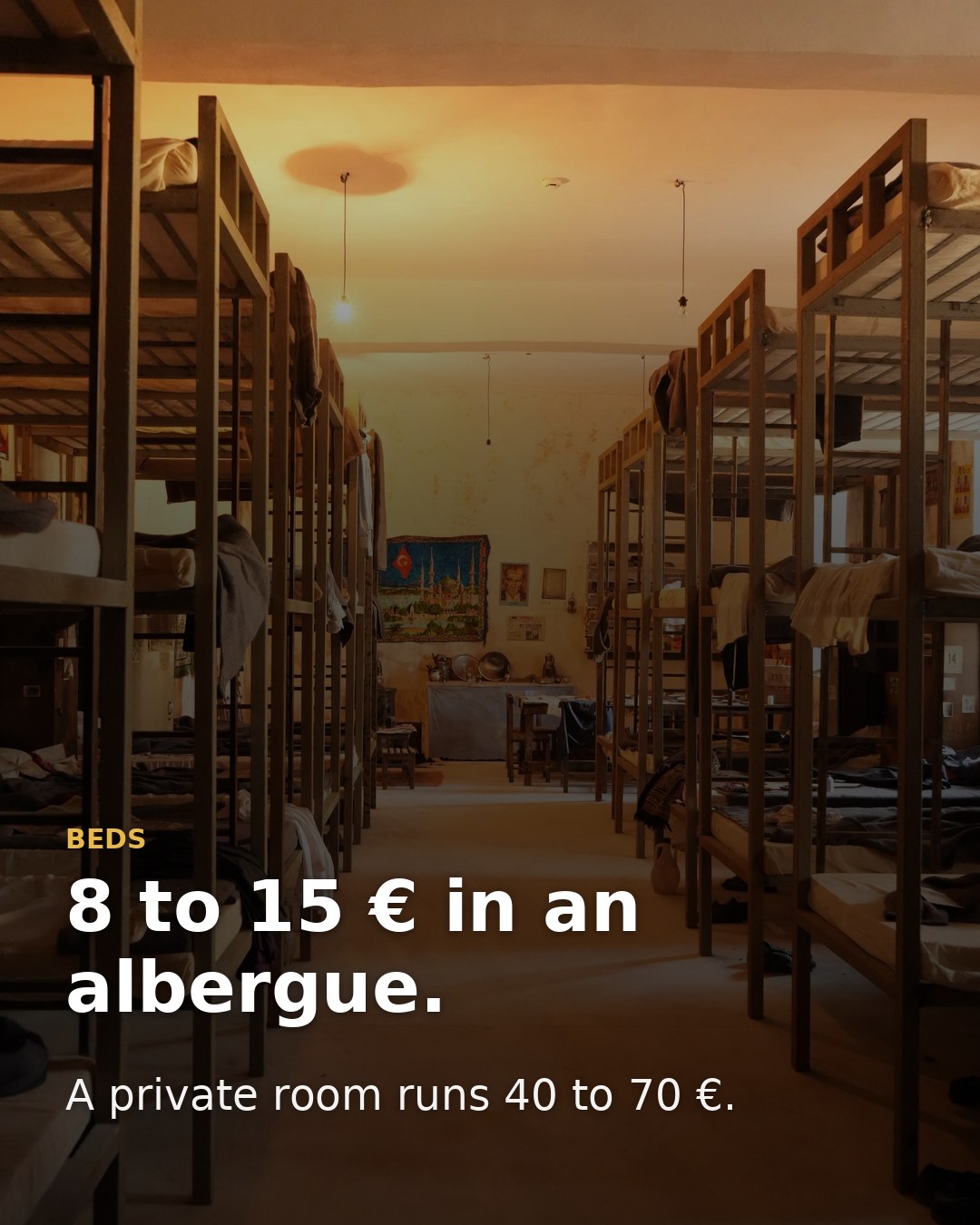
- Municipal / parish albergues: the classic pilgrim dormitory, often donation-based ("donativo") up to roughly €8–15 a night. Cheapest by far, but bunk beds, shared bathrooms, no booking.
- Private albergues & hostels: a dorm bed in a nicer, bookable place, ballpark €15–25.
- Guesthouses & small hotels: a private double room with its own bathroom, at very roughly €50–90 split between two, more in Pontevedra or peak season.
If you're not sure which world is for you, the trade-offs (privacy, sleep, atmosphere, cost) are worth thinking through properly before you book. They're laid out in full in where to sleep on the Camino Português: albergues vs hotels.
How much should I budget for food?
Portugal and Galicia are kind to a walker's wallet. A typical day:
- Breakfast: coffee and a pastry, a couple of euros. Many guesthouses include it.
- Lunch: a café sandwich or a picnic from a supermarket, €4–8. Picnicking is where budget walkers save the most.
- Dinner: the menú do peregrino (pilgrim menu), usually three courses with bread and a drink, runs roughly €12–16 in most towns. À la carte and you'll spend more, but the seafood is worth it at least once.
Budget €15–20 a day if you self-cater and picnic; €25–35 if you eat out properly each evening. The free mineral foot-baths in Caldas de Reis, happily, cost nothing.


How much does moving your bags cost?
Bag transfer (your pack carried ahead to the next town while you walk with a light day-pack) is the single best-value upgrade on the Camino. It typically costs in the region of €7 to €8 per bag per stage when arranged on the trail. Over 12 days that's perhaps €85–120, and walkers who pay it almost never regret it: it's the difference between savouring the day and grinding through it. If you'd rather carry everything, it costs nothing, but pack ruthlessly first, because every kilo is one you haul up every hill. The Camino packing list will help you cut the weight.
The smaller lines that add up
- Pilgrim passport (credencial): a couple of euros, once. You need it for albergues and the Compostela.
- The Compostela certificate: free to receive in Santiago (there's a small charge only if you want the fancy printed distance certificate or a tube to carry it home).
- Drinks, coffees, the odd treat: a beer or wine is €1.50–3; budget a few euros a day for the little stops that make the walk.
- Laundry: €4–6 a load at many albergues, or wash by hand for free.
- The "just in case" buffer: blister plasters, a pharmacy visit, a rest-day splurge. Keep €5–10 a day spare.
Getting there and home
Flights are the wild card and sit outside the daily walking budget entirely. They swing with where you're coming from and how early you book. The route bookends nicely through two airports (fly into Porto, home from Santiago, or vice versa), which usually beats backtracking. Add the small set-up costs too: an eSIM for data, an airport transfer, travel insurance; they're modest, but worth budgeting so nothing's a surprise.
What do three sample budgets look like (12 days)?
Shoestring: roughly €450–600. Municipal albergues, picnic lunches, pilgrim menus, carrying your own pack. Entirely doable and many pilgrims love it; you trade comfort and privacy for cost and a certain camaraderie.
Middle: roughly €750–1,000. A mix of private albergues and the occasional guesthouse, eating out most nights, bags moved on the longest days. The sweet spot for a lot of people.
Comfortable: roughly €1,100–1,800+. Private rooms with your own bathroom every night, bags transferred end to end, dinners chosen for the food not the price. This is the organised-holiday version: you still walk every step, you just don't manage the logistics or sleep in a bunk.
All three exclude flights, and all three are ranges, not promises; season, standards and exchange rates move them. Use them to pick your style, then price your own real dates.
Seven ways to walk it for less (without making it miserable)
If the budget is tight, here's where the real savings live, none of which spoil the walk:
- Picnic your lunches. A supermarket roll, cheese, fruit and a pastry eaten on a wall with a view costs a third of a café stop and is often nicer. This is the single biggest daily saving.
- Lean on the pilgrim menu. Three courses with bread and a drink for €12–16 is the best-value hot meal you'll find; save à la carte for the seafood night you'll remember.
- Mix your beds. Albergues most nights, a private room every third or fourth day to actually sleep. You bank the savings without burning out.
- Use the kitchens. Many albergues have a communal kitchen. A shared pot of pasta with the people you've been walking beside costs a couple of euros and makes the evening.
- Carry a refillable bottle. Tap water is fine across the route and there are public fountains; you'll save a fortune in bottled water over two weeks.
- Walk in the shoulder season. Late spring and September bring better prices as well as kinder weather and thinner crowds; see when to walk the Camino Português for the month-by-month.
- Travel light enough to carry your own pack. Skipping bag transfer saves €85–120 over the route, but only do it if you've packed light, because a heavy bag costs you in blisters and rest days instead.
Do I need cash, or are cards enough?
A practical note that saves stress: carry some cash. Donation-based municipal albergues, small village cafés and a few rural guesthouses are cash-only or card-shy, and ATMs thin out between towns. Cards work fine in cities and most hotels and restaurants, but you don't want to arrive at a donativo with only a phone. Both Portugal and Spain use the euro, so there's no currency change when you cross at Tui. Just keep a stash of small notes and coins for stamps, coffees and the collection box. A travel card with low foreign-transaction fees is worth setting up before you fly; so is making sure you can get online the moment you land, that's the eSIM's job.
Where does the money really go wrong?
The expensive mistakes on the Camino are rarely the nightly rates. They're the unplanned ones. Arriving in a full town at 6pm and taking the last, overpriced room. A taxi back to a bed you couldn't find. A rest day you hadn't budgeted because your feet gave out from a too-heavy pack. The cheapest Camino is a planned one. For the full picture (route, season, training and packing, all of which quietly affect what you spend), start with the complete guide to walking the Camino Português.
What if I'd rather not manage any of it?
Independent operators sell a walking package that folds beds, bag transfer and route notes into one arranged trip. You pay more than the shoestring number, but you walk light, sleep in a booked room every night, and never spend a precious evening hunting for somewhere to stay. Whether that's worth it depends on your trip and your temperament; both ways get you to Santiago on your own two feet.
Our pick
For most walkers the middle budget, roughly €750–1,000 for 12 days, is the sweet spot: a mix of private dorms and the odd guesthouse, dinner out most nights, and bags moved on the longest stages so they don't break you. Go shoestring if the camaraderie of donativo albergues is part of the appeal and you're happy carrying your pack; go comfortable if real sleep and zero logistics matter more than the saving. There's no wrong number here, only the one that matches how you want to walk.
Next steps: sharpen your number against the choices that drive it: where to sleep (albergues vs hotels), what to pack so you can skip bag transfer, and when to walk for better shoulder-season prices.
Common questions
How much does it cost to walk the Camino Português?
Roughly €35–50 a day if you keep it simple (municipal albergues, picnic lunches and pilgrim menus) and €90–150+ a day in comfort, with private rooms, nicer dinners and your bags moved. For a 12-day Porto-to-Santiago walk that is broadly €450–600 on a shoestring versus €1,100–1,800 in comfort, before flights. These are ballpark ranges, not quotes; prices move with season and standards.
What is the biggest cost on the Camino Português?
Where you sleep. Municipal albergues can be donation-based or a few euros; private dorms run roughly €15–25; a private guesthouse double is very roughly €50–90 split between two. Accommodation is the single biggest lever on your total spend.
How much does bag transfer cost on the Camino Português?
Bag transfer (your pack carried ahead to the next town while you walk with a daypack) typically costs in the region of €7 to €8 per bag per stage when arranged on the trail, so perhaps €85–120 over 12 days. It is widely rated as the best-value comfort upgrade, but carrying your own pack costs nothing.
Is the Compostela certificate free?
Yes, the basic Compostela is free to receive in Santiago. There is a small charge only if you want the printed distance certificate or a tube to carry it home. The pilgrim passport (credencial) you need for albergues and the certificate costs a couple of euros.
Do I need cash on the Camino Português?
Yes, carry some cash. Donation-based municipal albergues, small village cafés and some rural guesthouses are cash-only or card-shy, and ATMs thin out between towns. Cards work fine in cities and most hotels and restaurants. Portugal and Spain both use the euro, so there is no currency change when you cross at Tui.